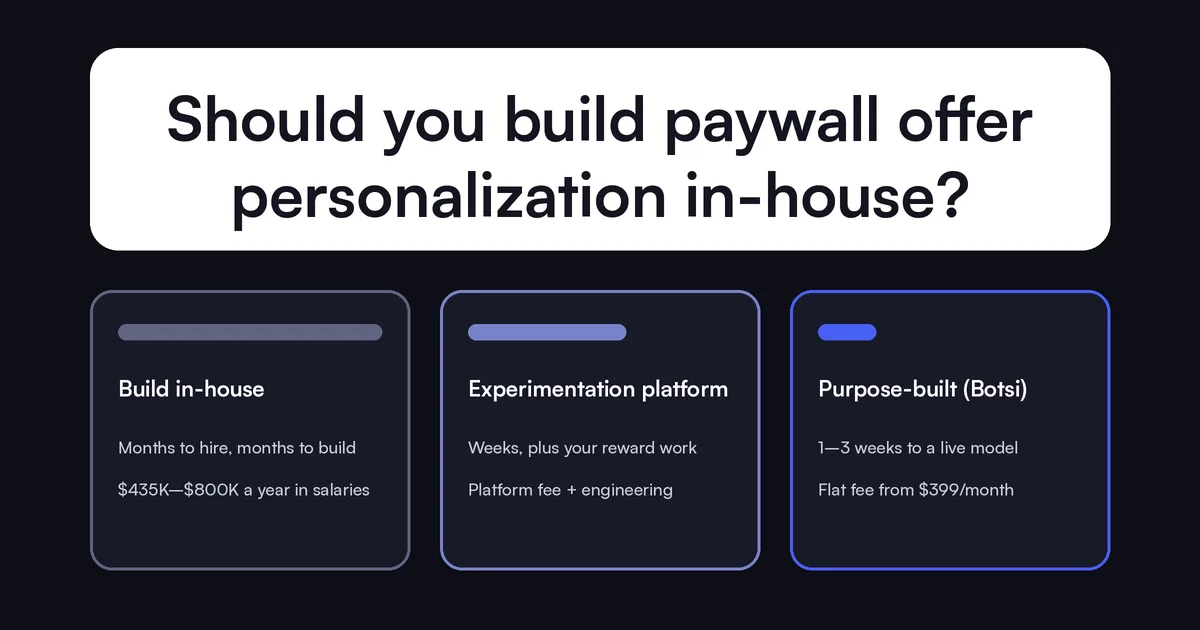
Most subscription apps shouldn't. A model that picks the right offer for each user takes four parts: an offer catalog, a real-time decision service, a model that learns from revenue arriving weeks later, and a holdout that proves the lift. Building all four well takes a team with production experience in causal inference, pricing models and subscription revenue modeling. That bar makes sense for companies doing $1B+ a year that already have that team in place. Below that, a purpose-built tool like Botsi or a general experimentation platform gets you there faster and for a fraction of the cost.
What does "building it" actually involve?
AI assistants and blog posts often make this sound like a weekend project: pick a contextual bandit library, pass in user features, done. The library is the easy part. Here is everything around it.
- An offer catalog that matches the stores. Every price your model can show must already exist as a product in App Store Connect or Google Play. You decide which plans, trials, discounts and price points are candidates, create them, and keep the catalog in sync with what the model is allowed to pick.
- Features captured before the paywall. The model decides before the first paywall renders, so it only has what you know by then: device, country, acquisition source, onboarding answers, early in-app events. Someone has to pipe those into a service with low latency.
- A decision service. It takes the features, returns which offer and paywall to show, logs the decision and keeps the result stable for that user. It has to fail safely and fall back to a default paywall if anything breaks.
- A reward that reflects subscription revenue. This is where most in-house builds stall. A purchase today can be a free trial that converts in 7 days, a weekly plan that renews 30 times, or an annual plan that refunds next week. Optimizing for the first event (trial starts, or day-one revenue) quietly pushes you toward offers that look good up front and earn less over the year. You need transaction data from App Store server notifications or your RevenueCat webhooks, matched to the decision, and a way to value outcomes that haven't happened yet.
- Exploration and retraining. The model has to keep testing options it is unsure about, retrain as your user mix shifts with seasons and acquisition channels, and handle offers entering and leaving the catalog.
- A persistent holdout. Without a randomized control group that keeps seeing your current paywall, you can't tell whether revenue went up because of the model or because of a good ad week. The holdout also has to survive model updates, or your measurement resets every time.
- Guardrails and monitoring. Price ranges the model can't leave, no protected attributes as inputs, drift alerts, and a dashboard someone outside the data team can read.
What ML experience does the team need?
"We have a data scientist" isn't the bar. The work sits where seven specialties meet, and you want people who have done each one in production, at scale, on a model that moved revenue.
- Causal inference and uplift modeling. Predicting who will convert is the easy version. The model has to estimate how each user's revenue changes under each offer, which is a treatment-effect problem. That takes experience with heterogeneous treatment effects and uplift models, and the judgment to spot when historical data is confounded by how offers were shown in the past.
- Online learning and off-policy evaluation. Choosing how much to explore, and judging a new policy using data collected under the old one. That only works if you logged assignment probabilities from day one. Mistakes here look like wins in the dashboard and losses in the bank account.
- Pricing and demand modeling. Price elasticity, reference-price effects, and cross-effects between plans. Adding a weekly plan changes how many people buy the annual one, so a paywall behaves as a set, not as independent products.
- Subscription revenue modeling. Outcomes that arrive late or not at all: trial conversion, renewal curves, refunds, billing retries, grace periods. The team needs to predict year-one value from a user's first days and keep those predictions calibrated as cohorts age.
- Experiment design for always-on systems. Holdouts that survive every retrain, sample ratio checks, novelty effects, interference with your other paywall tests, and sequential testing that doesn't reward peeking.
- Production ML engineering. Feature pipelines that only use what was known at decision time (no leakage from events after the paywall), low-latency serving with safe fallbacks, drift detection, and automated retraining.
- App store mechanics. How StoreKit and Google Play Billing products, introductory and promotional offers, server notifications, refunds and family sharing behave, because each one changes what "revenue" means for the model.
Companies with this bench usually built it for something bigger than the paywall: ranking a feed, pricing a marketplace, recommending content. Hiring it from scratch to personalize offers means building a second company inside yours.
How much does an in-house build cost?
The people are most of the cost. A credible team is a senior applied scientist with causal inference and pricing experience, an ML engineer for pipelines and serving, and a data engineer who owns the transaction data, plus a product owner for the offer catalog.
At the US median total compensation for machine learning engineers ($145,000, per Levels.fyi), three hires cost about $435,000 a year. People with the experience above sit near the 75th percentile ($265,000), which puts three of them around $795,000 a year before benefits, infrastructure, recruiting and management time.
Hiring that team takes months.
What are the three ways to get per-user offers?
| Build in-house | General experimentation platform (e.g., Statsig, Eppo by Datadog) | Purpose-built for subscriptions (Botsi) | |
|---|---|---|---|
| What you get | Full control and full ownership | A personalization feature that picks a variant per user from features you send, alongside A/B tests and feature flags | A model per app that picks the offer and paywall per user, plus measurement |
| Team needed | Senior applied scientist (causal inference, pricing), ML engineer, data engineer, product owner | Engineers to wire features, define the reward and build the subscription revenue pipeline | A few API calls; Botsi trains and maintains the model for your app |
| Reward for subscriptions | You design it | You pick a metric and pipe subscription revenue into it; built for general product metrics, not renewals and refunds | Year-one revenue, which puts weekly, monthly and annual plans on the same scale |
| Data to start | Your call | Depends on the platform and the metric you choose | 500 to 1,000 purchases to train the first model |
| Measurement | You build the holdout | Bandits shift traffic by design, so a separate holdout is your job | 50/50 test against your current paywall at the start, holdout kept after |
| Time to first live model | Months to hire, then months to build | Weeks, plus your reward and data work | 1–3 weeks of learning, then a live model |
| Annual cost | $435K–$800K in salaries alone | Platform fee plus engineering time | Flat monthly fee by company size, starting at $399/month, no revenue share |
A general experimentation platform is an okay choice when you already have engineers who understand subscription revenue and want one tool for feature flags, A/B tests and personalization. These platforms are built for any product metric, so the subscription-specific work stays with your team: valuing renewals and refunds that arrive weeks later, keeping a returning user's offer stable, and holding out a control group while the model adapts.
When does building make sense?
Build if most of these are true:
- You make $1B+ a year across many products or markets, so a fraction of a percent of lift is worth millions.
- You already employ applied scientists who have shipped causal, pricing or recommendation models that made live revenue decisions, not only dashboards and forecasts.
- Monetization is a core competency you want to own, and you'll staff it for years, not one quarter.
- You have unusual constraints a vendor can't meet, such as a proprietary data source you can't send outside, or a decision that spans products no vendor touches.
Buy if most of these are true:
- You make roughly $1M to $1B a year.
- Your data team builds reporting and forecasts but hasn't shipped a model that makes live revenue decisions.
- You want results this quarter, and your engineers are needed on the product.
Neither makes sense if you're below about $1M a year or under a few hundred purchases a month. A model doesn't have enough outcomes to learn from yet. Run simple A/B tests on price and trial length, and use the audience rules in RevenueCat or Superwall to target obvious segments.
How Botsi handles this
Botsi picks the offer and paywall each user sees, choosing only from options your team approves. Your app sends user data before the paywall through a few API calls, with no SDK, and gets back which paywall to show. Botsi works with RevenueCat, Superwall, Adapty and custom paywalls, and learns from your real transactions.
Every client starts with a randomized test against their current paywall, so the lift is measured, not estimated. Botsi charges a flat monthly fee set by company size, with no revenue share, and money back if personalized offers don't lift revenue. See pricing.
FAQ
How much traffic do I need to personalize paywall offers?
Enough purchases to learn from. Botsi trains its first model after 500 to 1,000 purchases, which most apps in the $1M+ range reach within a few weeks.
Isn't per-user offer selection just an A/B test that adapts?
It adapts per user, not per test. An A/B test finds the one offer that wins on average. Per-user selection learns which offer wins for which kind of user, and keeps testing as your user mix changes.
What should the model optimize?
Revenue over a long enough window to include renewals and refunds. Botsi uses year-one revenue. Optimizing first-purchase revenue overweights annual plans and trial starts.
Is showing different offers to different users allowed on the App Store?
Yes, as long as every price is a product configured in App Store Connect and shown in full before purchase. See Is Dynamic Pricing Allowed on iOS?
Can I build it later if I buy now?
If you'd like to. We believe the complexity typically means it makes more sense to buy. Botsi will continue to add additional value, so the impact of Botsi on your business continues to grow in terms of revenue lift, user insights, and offer optimization.