Michael Berliner led growth at Masterclass and Calm before founding Otter Growth, which works with subscription apps on onboarding, paywalls and activation. At Masterclass he built one of the first quiz-style onboarding flows. At Calm, a two-week revamp of the self-serve flow lifted conversion 50%, and a rebuilt activation flow lifted return retention 30%. He joins the Price Power Podcast to talk through how onboarding, paywalls and activation fit together, from the early days of quiz funnels to the paywall tests he runs with clients today.
Ten Tips from the Episode
1. Friction that builds intent raises conversion
Five or six years ago, Masterclass onboarding was a product page, a Get Started button and checkout. Users told the team they weren't sure they'd watch enough classes to justify the price. So the team borrowed from Noom's famously long onboarding and built a quiz that showed people what they'd get out of it.
Conversion went up 20%, and the wins kept coming. Michael's VP of product spent the whole time asking how more friction could possibly help.
Friction isn't the enemy. Confusion is. Questions that reinforce value and help users picture their own results build the intent your paywall needs.
2. Onboarding is part of the product in some categories
Quiz flows don't work for every app. Michael draws the line at motivation. Education, wellness and personal finance apps ask people to do hard things they don't naturally want to do, so onboarding has to set goals and build motivation. In those categories, onboarding is partly the core product.
Strava sits on the other side. People open it because they want to track a run right now, and every extra screen gets in the way.
Acquisition source matters too. A Meta user was scrolling in bed and never planned to solve anything, so you have to work harder to convince them. A search user arrived with a goal. Get them to it fast.
3. Start with one flow and earn your segments
Branching onboarding by segment sounds smart, and at scale it is. Gamma built different onboarding, activation and paywalls for hardcore professionals and casual users. But each branch shrinks the traffic you can test on.
Michael put numbers on it: if a segment gets 30% of traffic, a 10% win in that branch is a 3% win overall. You've added complexity and slowed your execution velocity for a smaller result.
Split only when use cases differ enough that one flow becomes a bad experience, like sleep vs general meditation. Masterclass only segmented after the single flow stopped producing gains.
4. Install to trial start sets up everything after it
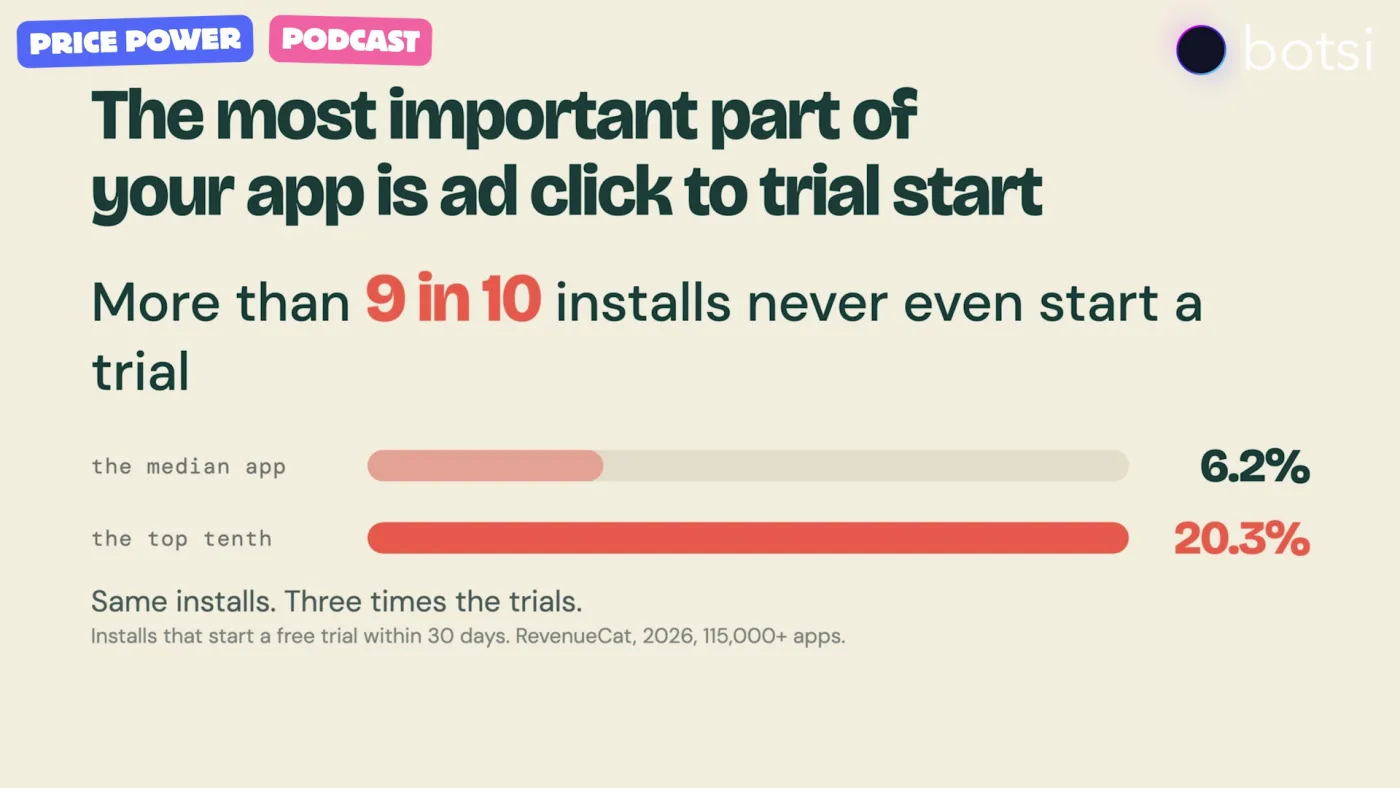
Michael's "Ideal Flow" talk makes a deliberately bold claim: install to trial start is the most important part of your app. The leaky bucket argument says to fix retention first, but whether users stay depends on that first experience.
The average install to trial start rate is about 6%. Most people never get to try the core product. Apps with well-built onboarding convert 2 to 3 times better, and they set users up to activate.
That doesn't mean chasing trial starts at any cost. Michael's north star is LTV to CAC. Showing the paywall earlier inflates trial starts with low-intent users, so judge every change by its effect on revenue per install.
5. Give people a reason before you ask for an account
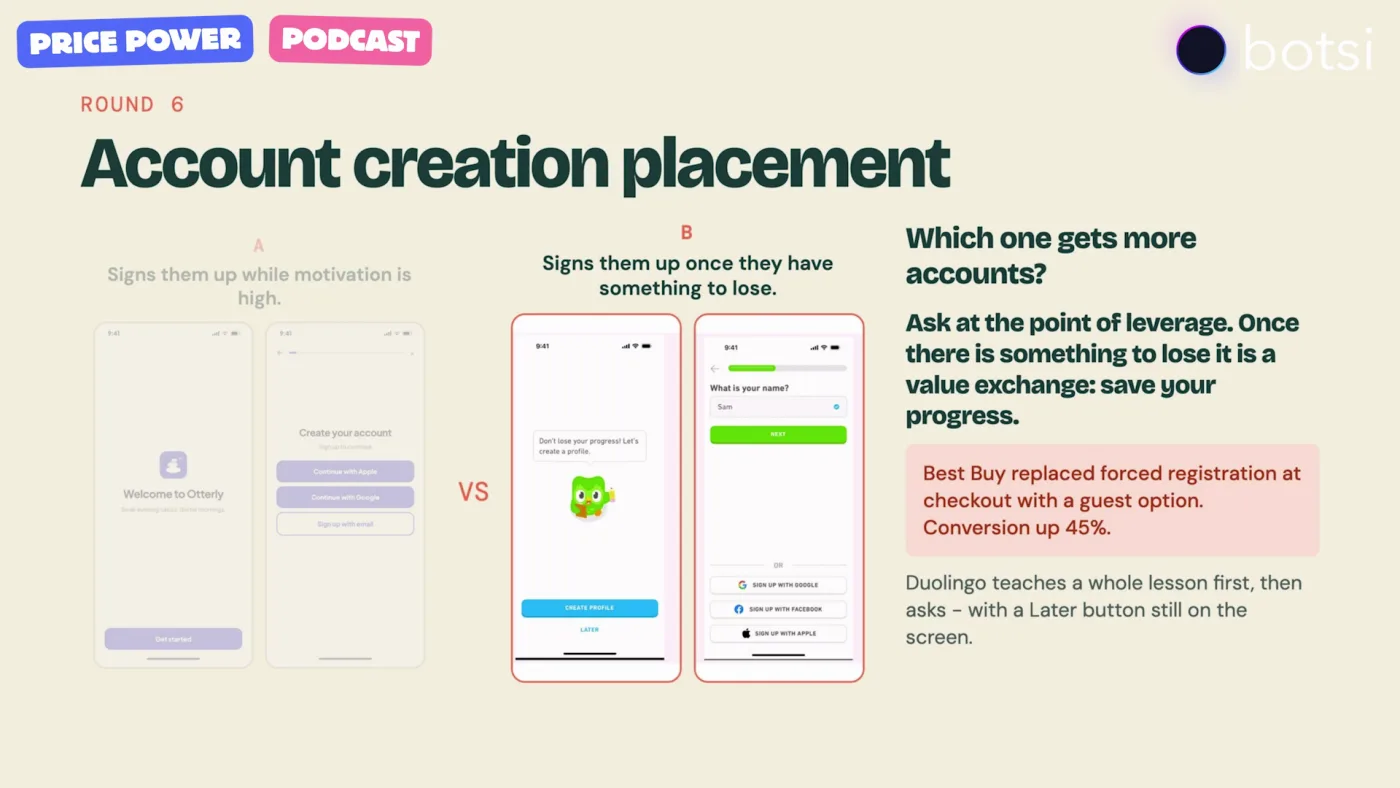
Account creation is a high-commitment ask, and people are more skeptical about handing over their details than they used to be. Michael's rule is that the bigger the ask, the more you need to justify it.
His favorite placement: after users have answered questions and received a personalized plan. "Create your account to save your plan" is easy to say yes to.
Jacob has seen early account creation raise trial-to-paid conversion too, because people who won't make an account were never going to start a trial. Both placements can win. Product type matters, since a simple utility app feels like overkill while a fitness app that knows your goals doesn't. Test it in a few places and do the math across the whole funnel.
6. Show, don't tell before the paywall
Putting part of the core product into onboarding breaks traditional logic, because it adds cognitive load before the paywall. Duolingo does it with a real lesson. Michael is surprised it works there, since an educational exercise usually cools excitement.
For AI apps it matters even more. Users have never experienced what something like Tolan does, so text can't explain the value. Letting them meet their companion before paying is the pitch.
Jacob prefers to think of the aha moment as a series. A photo editing app shows a before-and-after for your use case. A plant app runs a simulated identification. Neither is the full product, but both give a hint of value. Michael's warning: try two or three tests, then take an honest look at whether your product can do this at all.
7. The paywall is the most anxious screen in your app
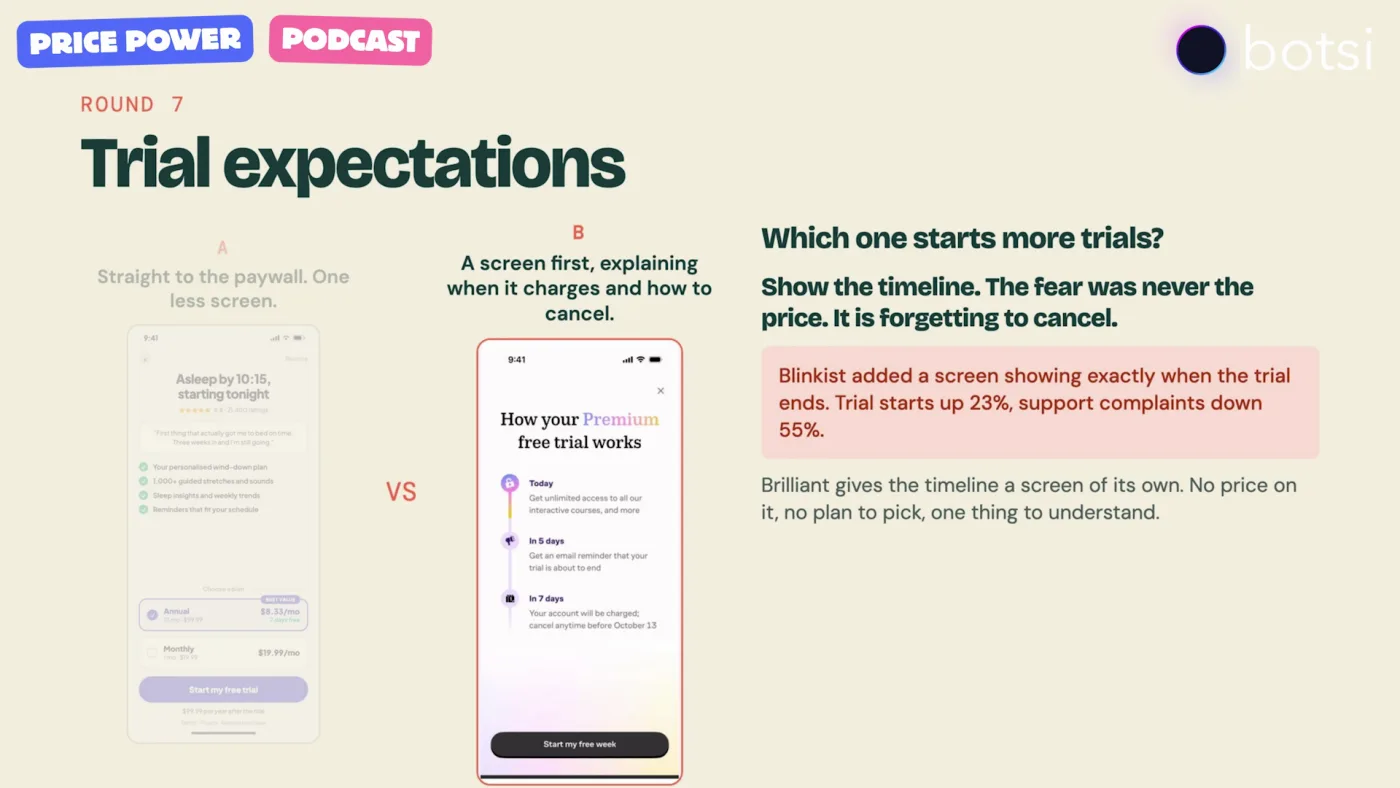
Blinkist added a trial timeline before its paywall: what happens on day 1, day 3 and day 7, plus a reminder before renewal. Trial starts went up 23% and complaints dropped 55%.
It looks risky, since reminders should increase cancellations. Michael explains that users arrive at the paywall already paying for ten subscriptions, and anything that says "we have your back" turns into trust. The people who cancel after a reminder were mostly going to leave anyway.
Jacob's addition is that reminders also cut day-zero cancellations from people who sign up and cancel immediately to protect themselves.
8. Defaults decide your plan mix
Annual plans usually carry twice the LTV of monthly or weekly. Mojo moved its monthly plan one screen deeper, behind a "See all plans" button, and annual share went from 60% to 80%. Imprint's paywall is famous for the same move.
This is the power of defaults. People assume whatever you show first is the normal choice, and few click "See all plans."
Make that button visible, though. Price-sensitive users need to find monthly, and you want the people in the middle to default to annual without losing the ones who never would.
9. A "no" at the paywall still tells you something
In one case study Michael shared, users who closed the paywall and went freemium converted at half a percent. When the app gave those users seven free days of premium with no card required, conversion for that audience rose 10x.
Michael's lesson is to have the right offer for someone who just declined, whether or not that offer is a reverse trial. They made it through your onboarding, so they're higher intent than anyone who dropped off. Check Apple's current rules before you show a second offer.
The same thinking applies after purchase. Masterclass shows three add-ons after checkout. Someone who just entered a card has told you they're willing to pay. Jacob's boldest version: show "Your free week just started, lock it in for 30% off?" the moment a trial begins, since around 60% of trial users won't continue anyway.
10. Your paywall isn't a sales page, and your A/B test isn't the final word
Michael's least favorite best practice is the long paywall that tries to sell everything. He sees one-job-per-screen breadcrumbing beat it 90 to 95% of the time. Selling belongs in onboarding. By the time users hit the paywall, the buying decision is often made and they're only choosing a plan, which is why copy and design tests rarely move much.
Jacob's pick was that A/B tests lie to you. Teams test into one winner without checking how it did by device, platform or acquisition source, then leave that price alone for two years. A January winner may not hold in July.
Michael sees 30 to 40% wins almost every time he changes pricing and packaging with clients, mostly because nobody had tested it. Even simple rules that show different offers to different people can unlock that.
Where to start
Treat onboarding and the paywall as one flow with one job: build enough intent that starting a trial feels like the obvious next step. Do the selling before the paywall, ask for commitment once users have something to lose, tell them exactly how the trial works, and let defaults steer plan mix. Then keep testing, because the users who said no and the users who just paid are both telling you what to offer next.
Resources
Otter Growth: https://ottergrowth.com
Michael's "Ideal Flow" presentation: https://ottergrowth.com/boa
Michael Berliner on LinkedIn: https://www.linkedin.com/in/berlinermichael/
Listen to the Full Episode
Youtube
Spotify
Apple Podcasts
Check out past episodes here: PricePowerPodcast.com