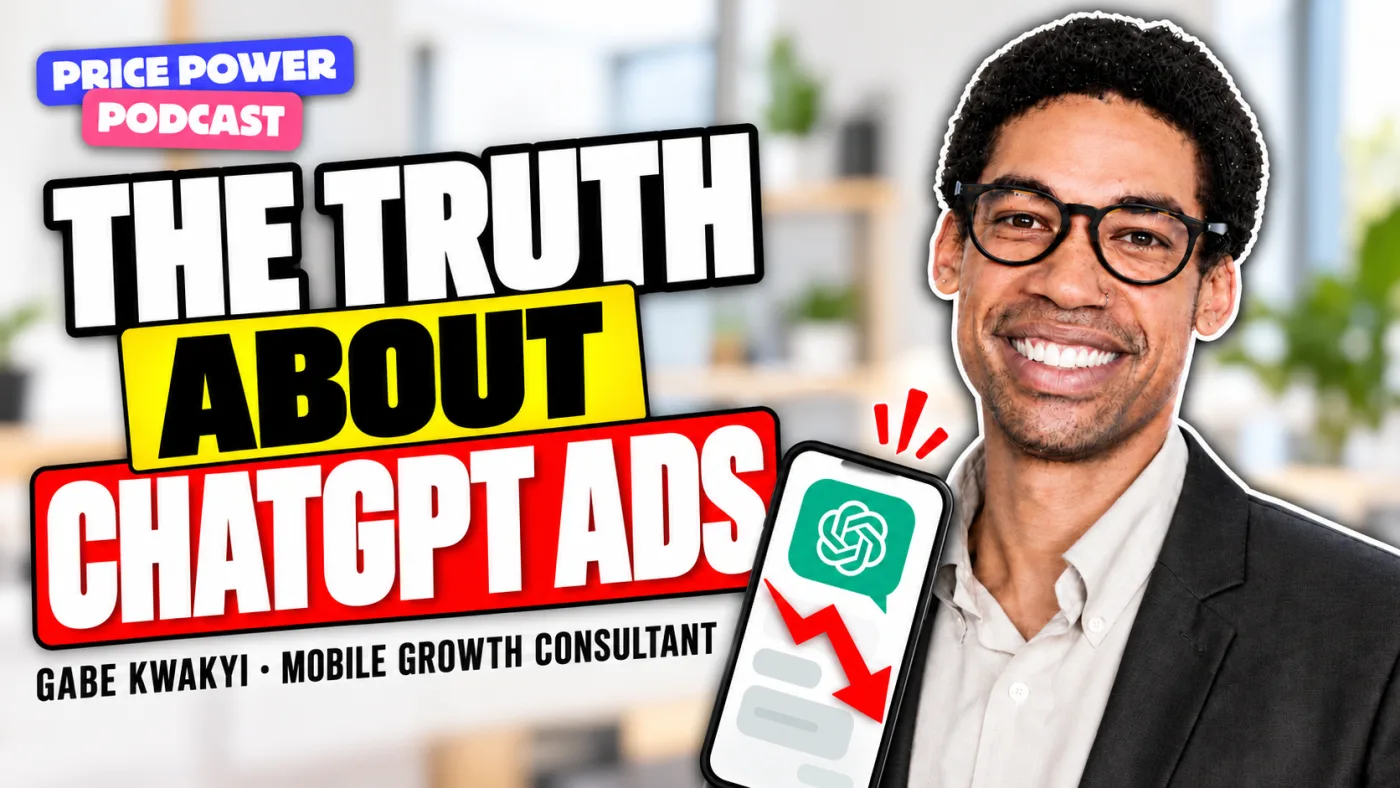
Gabe Kwakyi co-founded Incipia, an ASO and paid UA agency that worked with Coinbase, Walmart and PeopleFun. He was Director of ASO Performance Marketing at Phiture and Head of Growth at Lingvano, and he co-founded Rhythmic, an app studio where he runs most of his ChatGPT Ads tests. He was one of the first marketers testing Apple Search Ads when it launched, and he's taken the same early-adopter approach to ChatGPT Ads. He joins the Price Power Podcast to share how the platform works, why clicks aren't turning into purchases, and which context hints drove conversions.
Ten Tips from the Episode
1. ChatGPT Ads get clicks, not buyers
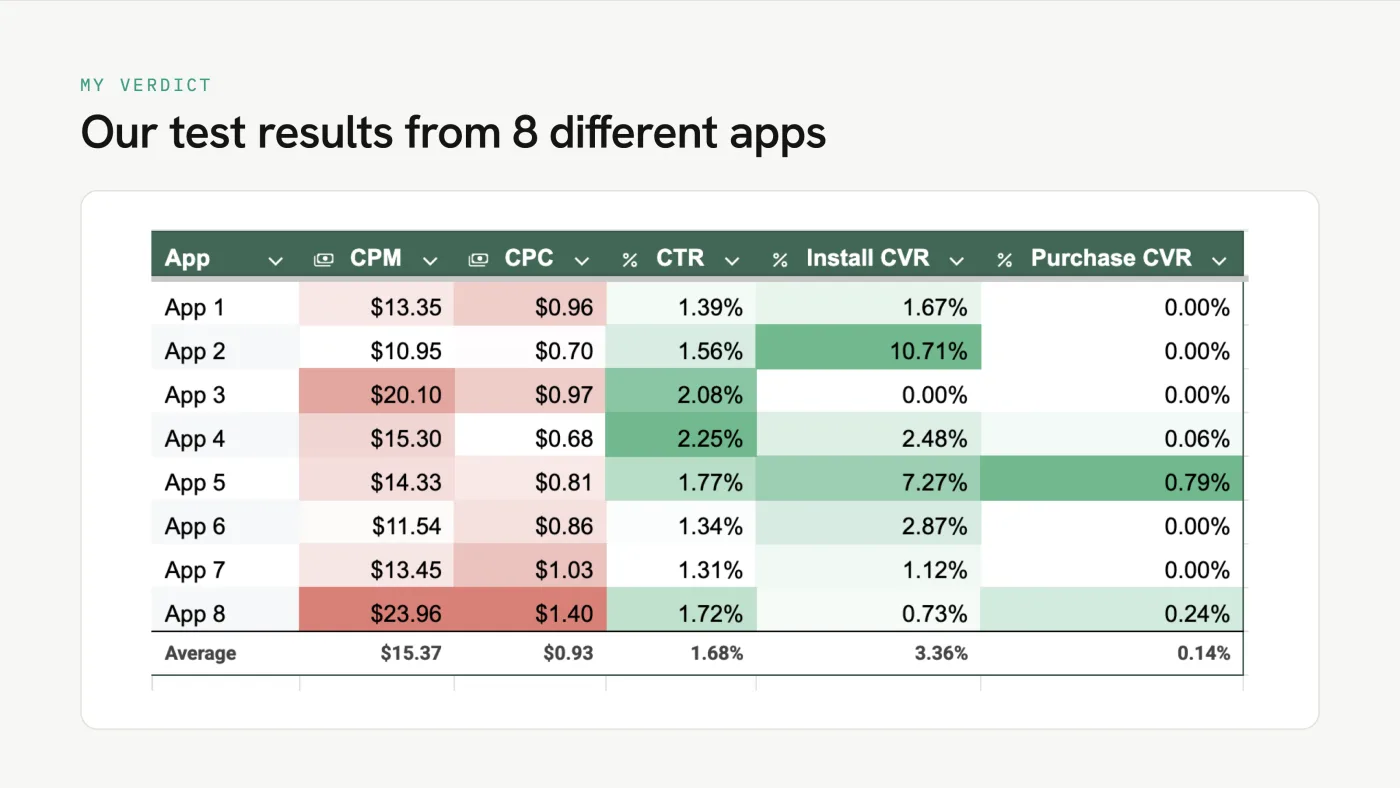
The headline finding is uncomfortable. Across eight apps, Gabe saw an average CPM of $15.37, CPC of $0.93 and a 1.68% CTR. Installs converted at 3.36%. Then the funnel fell off a cliff: purchase conversion averaged 0.14%, and five of the eight apps got none at all.
Gabe borrowed a phrase from another marketer to describe the traffic: "curiosity clicks." People tap the ad because it's new and right next to the answer they're reading. Few of them are ready to start a trial.
If you test, judge ChatGPT Ads on trials and purchases from day one. The top-of-funnel numbers will flatter you.
2. The real blocker is missing conversion data
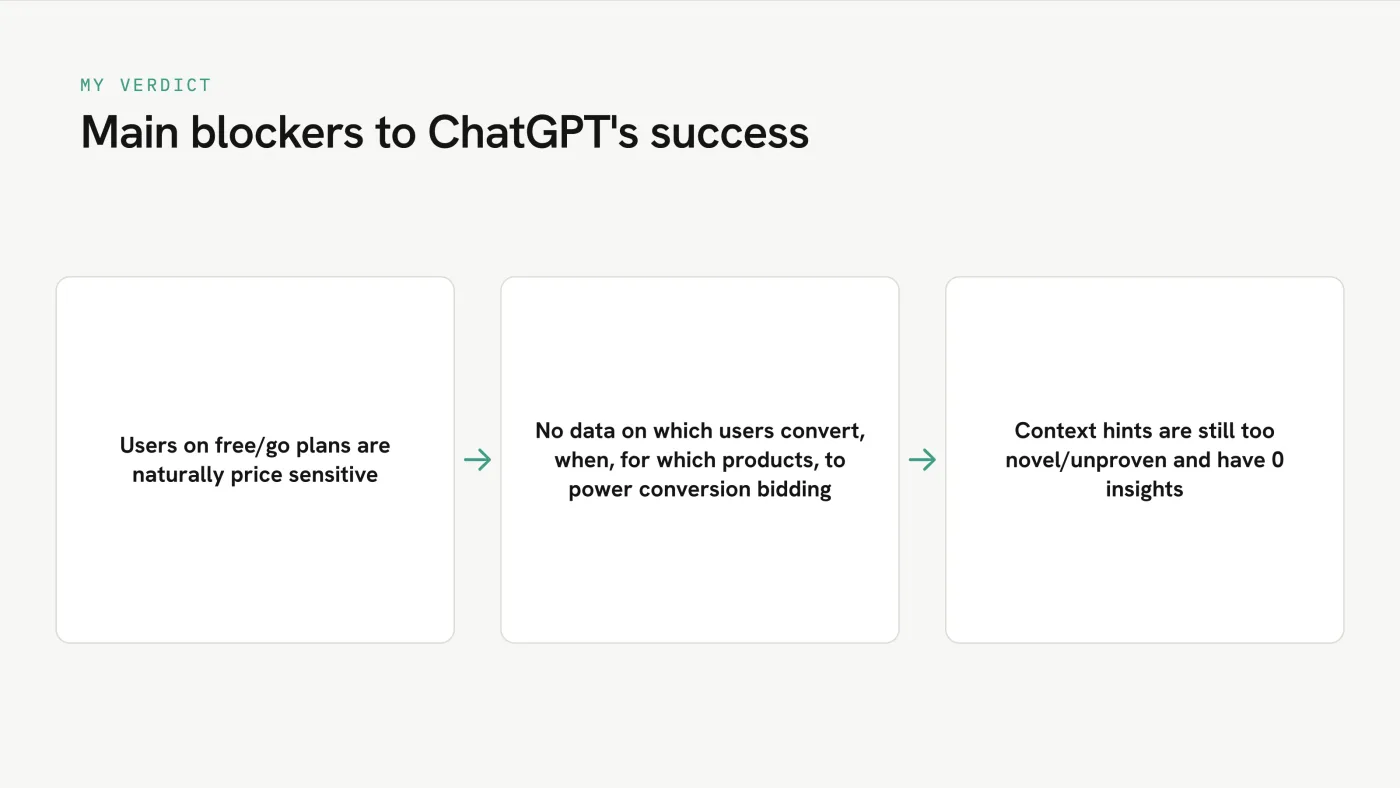
Meta's ad platform works because, for years, every advertiser sent back labeled events: this is a trial, this is a purchase, this is a content view. Meta learned which people converted, for which products, at which moments.
ChatGPT Ads launched self-serve in May 2026. OpenAI has deep data on what its users talk about, but almost no data on what happens after they click off-platform. Gabe points out that several of the people running ChatGPT Ads came from Meta. "They know how to make an ad platform work." What they need is postback volume.
That's why Gabe expects 2026 tests to mostly fail and 2027 to be the breakout year, if conversion bidding improves.
3. Context hints are your creative
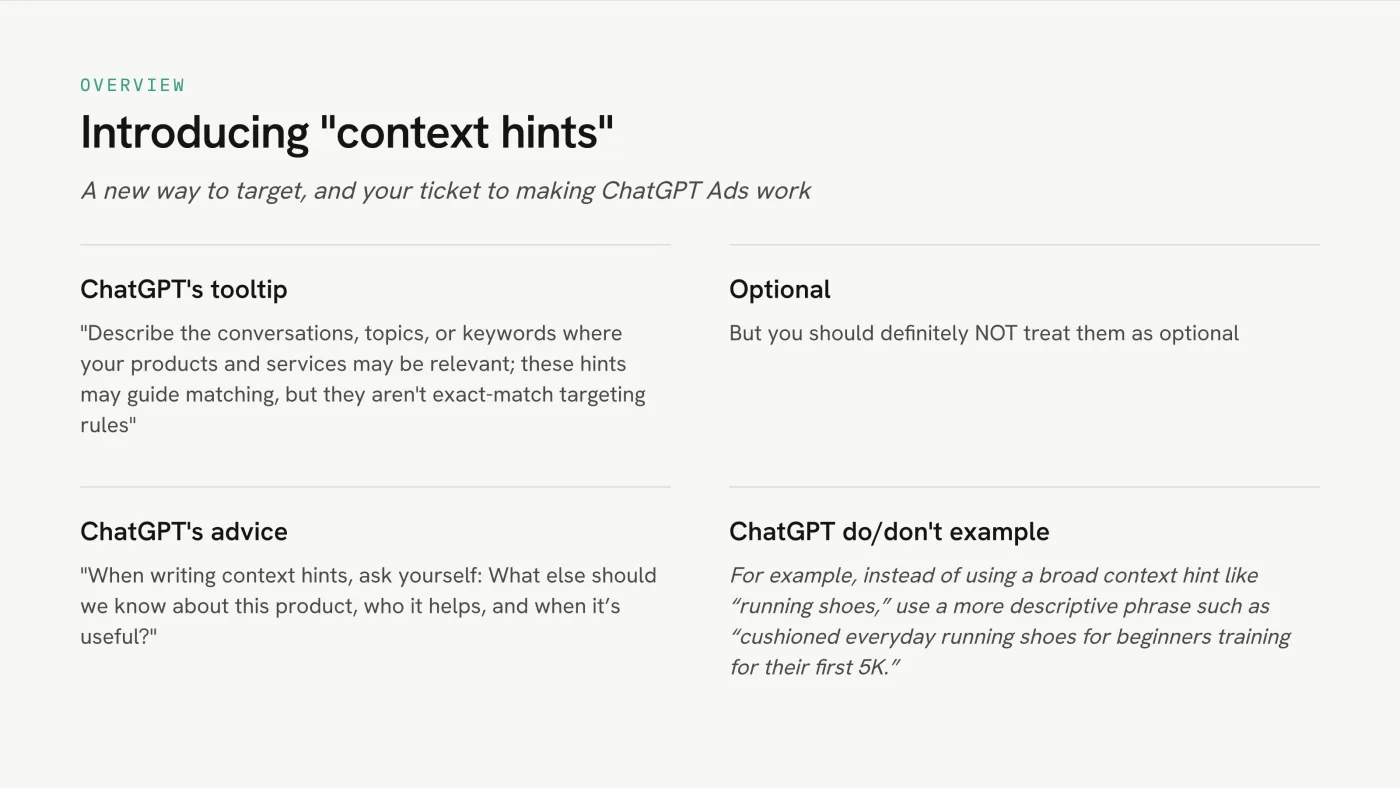
ChatGPT Ads have a minimal setup: country, platform, bid type and context hints. A context hint is a plain-language description of the conversations, topics or keywords where your product fits. ChatGPT treats it as guidance rather than exact-match targeting.
ChatGPT marks context hints as optional. Gabe says to always use them. With so little creative surface to work with, the hint is where your testing budget should go. He compares it to Meta, where each creative gets a set amount of spend before you judge it. On ChatGPT, each context hint plays that role.
Put one hint, or a few closely related hints, in each ad group so you can tell which one is performing.
4. Target the moment, not the topic
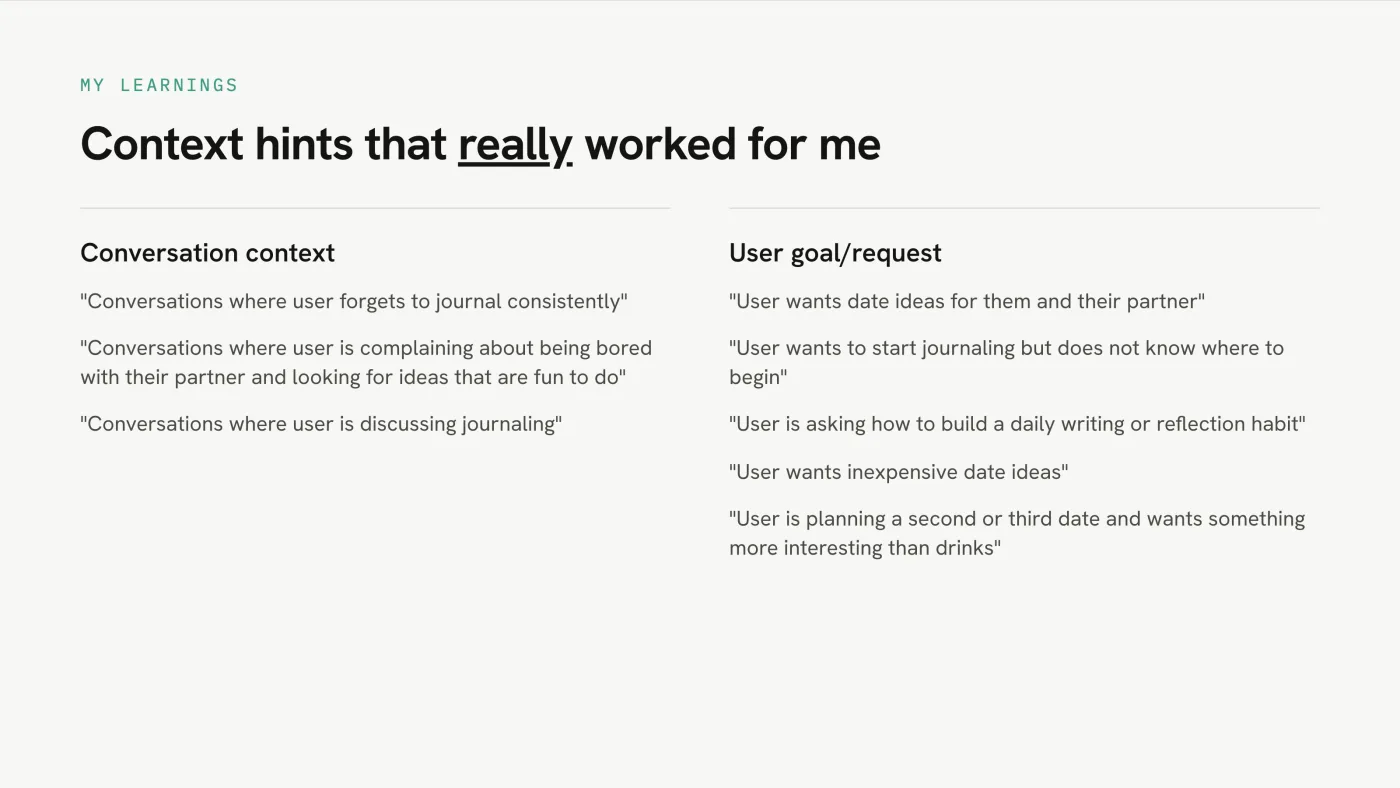
Gabe's first instinct was to target topics, like users who want date ideas. That gets volume, but people who ask ChatGPT for ideas are often browsing. "Give me five ideas. No, give me ten more." They aren't committed to solving anything.
What worked better was describing a moment of need. "User is planning a second or third date and wants something more interesting than drinks." "User wants to start journaling but does not know where to begin." These hints describe someone with a specific goal who hasn't solved it yet.
Write your context hints as a scene: who the user is, what they want and what's in their way.
5. Use the layup insertion
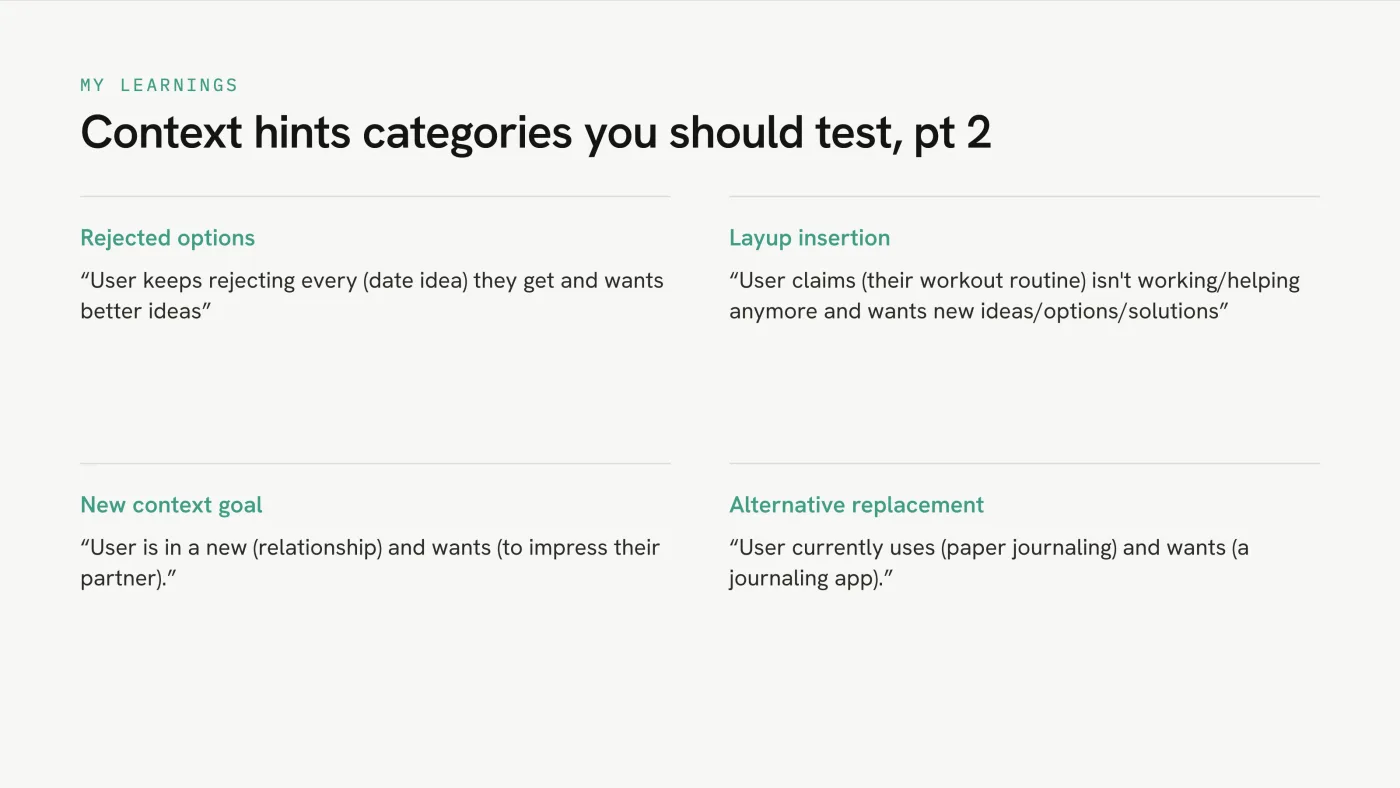
Gabe's most productive pattern has a name: the layup insertion. The template is "User claims X didn't work and they want better ideas." For example, "User claims their workout routine isn't working anymore and wants new options."
The user has qualified themselves. They've tried something, it failed, and they're asking for help. A close cousin is the rejected-options hint: "User keeps rejecting every date idea they get and wants better ideas." When ChatGPT's own suggestions fall short, your ad shows up as the alternative.
Google can't target this. A search ad sees one query. ChatGPT sees the whole frustrated conversation.
6. Think in turns
A turn is one exchange: the user asks, ChatGPT answers. Gabe thinks turn depth will matter a lot for ad performance. Someone asking for the best price on a flight is ready for a travel ad on turn one. Someone talking through their relationship might need ten turns before an app recommendation feels helpful.
You can't target by turn count yet; it's on Gabe's wish list. But you can approximate it with context hints that describe later stages of a conversation, like a user who has already rejected suggestions or is comparing several options.
7. Use your app icon as the image
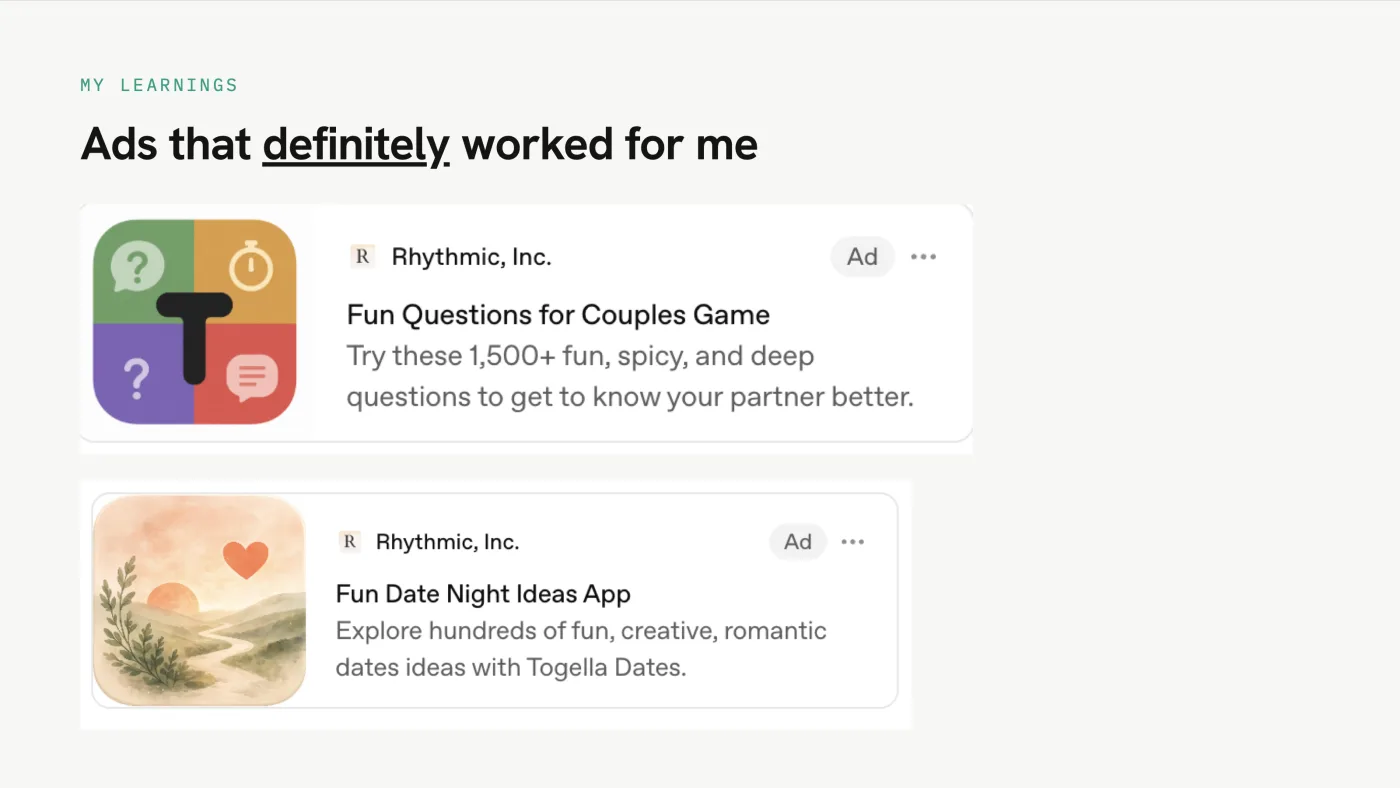
Gabe tested Meta creative, new designs and app screenshots. The plain app icon won every time. "It was kinda no contest."
The reason is placement. A ChatGPT ad image is a small square beside the text. Anything detailed becomes unreadable, and a busy banner looks out of place next to a helpful answer. An icon looks like a product recommendation, which is what the user expects to see. Jacob added that the icon also follows the user into the App Store, which confirms they're in the right place.
Titles max out at 50 characters and descriptions at 100, and ChatGPT warns that text may be truncated even within those limits. Keep copy short and plain.
8. Match your funnel to ChatGPT intent
Meta traffic usually needs a long, emotional onboarding: you interrupted someone's scroll and have to build desire. Search traffic needs the opposite, because the user came looking for a solution. ChatGPT traffic sits in between.
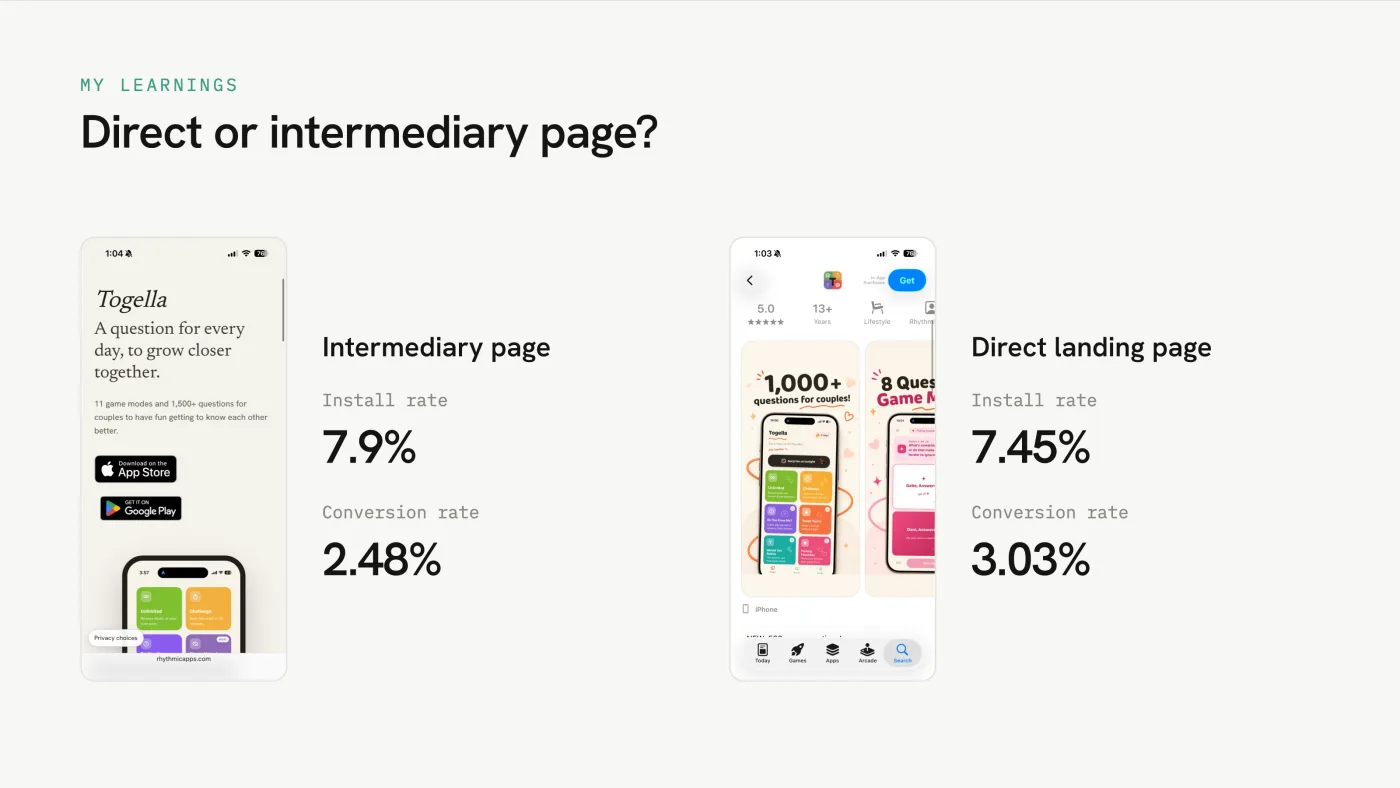
ChatGPT Ads currently pass five URL parameters: campaign ID, ad group ID, ad ID, account ID and "oppref," which works like Google's GCLID. With separate ads per context hint, you can use the ad ID to route each audience to a tailored web funnel. In Gabe's own test, sending users straight to a direct landing page converted at 3.03%, versus 2.48% through an intermediary page.
9. Check for an organic halo
One advertiser wrote on LinkedIn that they spent $600 on ChatGPT Ads, got zero attributed conversions, and then noticed a rise in organic ChatGPT referrals. Gabe has seen this before. When Apple Search Ads launched, search ads traffic correlated with organic keyword rankings until Apple fixed it.
ChatGPT Ads might be lifting organic visibility in ChatGPT answers right now. Desktop users who see an app ad and later search the App Store on their phone also won't show up in attribution. If you test, check your referrer data and "how did you hear about us" responses.
10. Test cheaply, and keep coming back
Setup is fast. You don't need new creative or a landing page; an MMP tracking link in the ad URL works. The minimum budget is $25 a day.
Gabe's verdict: if you need a new channel to work this quarter, skip it. If you want to learn the platform before it matures, test now at low budgets and retest every couple of months. He expects it to go from "meh" to "all right" to "oh yeah" within months, and the marketers who already understand context hints will move first.
Where to start
Start with the context hint, because ChatGPT Ads have a data problem rather than a targeting problem. The clicks are cheap and the purchases are rare because the platform doesn't yet know who buys. Until conversion bidding catches up, the hint is the lever you control: describe a specific, frustrated moment rather than a topic, use your app icon, and send each audience to a funnel that matches its intent. Test small, measure trials and purchases, and come back every few months.
Resources
Gabe Kwakyi on LinkedIn: https://www.linkedin.com/in/gabrielkwakyi/
Rhythmic apps: https://rhythmicapps.com/
Listen to the Full Episode
Youtube
Spotify
Apple Podcasts
Check out past episodes here: PricePowerPodcast.com