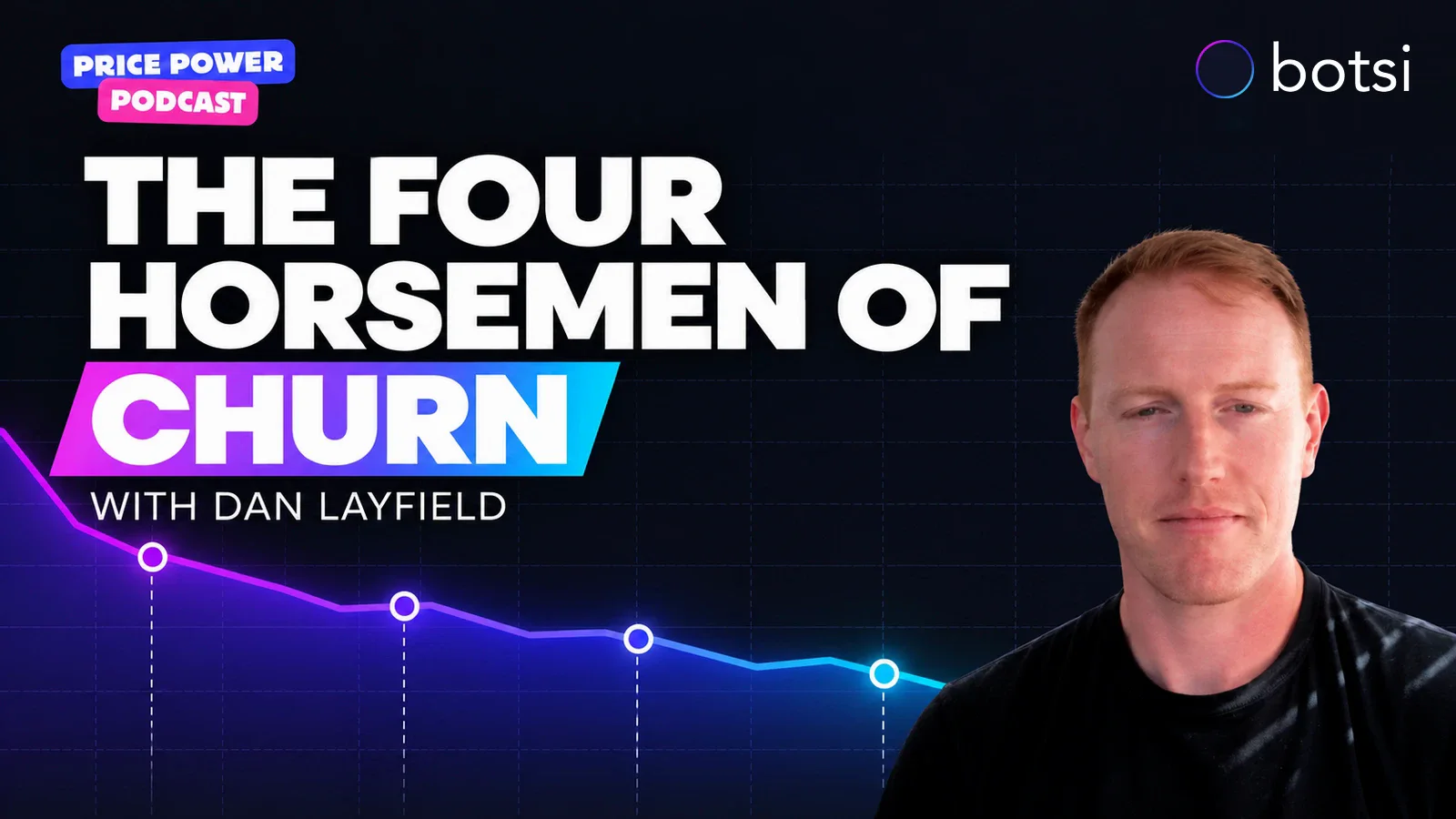
Dan Layfield joined Codecademy when it was around 20 people and left when it was 250, with ARR going from roughly $10M to $50M in that time, which meant working across the whole subscription model rather than one slice of it. He later worked on Uber Eats, and now writes Subscription Index. He joins the Price Power Podcast to break churn into its parts, because most teams treat it as a single number and throw a few projects at it each quarter.
Ten Tips from the Episode
1. Churn sets the ceiling on your entire business
Take new users per month and divide by your monthly churn rate, and you have the maximum number of subscribers you can ever hold. A thousand new users a month at 20 percent monthly churn caps you at 5,000 subscribers, because that is where the inputs and outputs cancel.
Divide one by your monthly churn rate and you get the average number of months a user sticks around. At 20 percent, that is five. Dan is candid that he did not know this framework while he was at Codecademy and picked it up afterward.
2. Churn is four problems, not one
Dan's four buckets: payments and technical failure, where cards fail or the app breaks. Selling to the wrong persona, where something in the marketing is pulling in people who do not have the problem you solve. Activation churn, where people never got to value. And happy user churn, where you solved the problem and they left.
The solutions do not transfer. A save offer does nothing for a payments failure, and a retry schedule does nothing for someone you should never have acquired.
3. Happy user churn isn't a failure
Someone arrives at Codecademy to learn SQL. It takes about fifteen hours. They learn SQL and leave, delighted. The product worked exactly as intended.
Dan's other example is better: he met his wife on Bumble, they have three kids, and he will never use Bumble again. In retrospect he probably owes them more than any product he has ever used. Separate it out: it is the one bucket you cannot win back, so spend no effort trying.
4. Optimize from the bottom of the funnel up
Best practices at the payments and checkout layer are clear, well documented and transfer between companies. Further up, in activation and conversion, problems get bespoke and the answers stop being generic.
So Dan starts at the bottom, where he can put points on the board quickly, and works upward. He also warns against the comfortable roadmap with ten parallel workstreams. Projects produce no value until they ship, and six months on something that turns out to be a dud costs you half a year.
5. Fix your Stripe settings this afternoon
Dan checks this first at every company he works with, and he says every Stripe account he has touched arrived configured badly.
Turn on smart retries and set them aggressively, eight attempts over four weeks. The goal is for the retry schedule to span as many pay periods as possible, since debit balances reset roughly every 14 days and credit cards around 30. Turn on the card account updater so an expired card gets re-attempted against the new one. Turn on dunning emails, and make sure the card update link does not force a re-login.
Ten minutes of configuration, often around five percent of churn recovered.
6. Retry timing is a modeling problem
Stripe's default behavior retries on a fixed cadence: three days after failure, then five, then seven. Dan calls these dumb retries.
The specialists in this space, Churnkey, Butter and FlexPay, use machine learning to predict when a retry will clear. Transactions get flagged as fraud inconsistently inside the card networks, and the outcome depends on the time of day and the data sent with the API call. A timer cannot model that.
7. Pause, discount, downgrade
For shorter-lifecycle products, which is most consumer subscriptions, the combination of pausing, a temporary discount, an upgrade or downgrade, and a route to a human knocks around 20 percent off churn.
The offers work when they solve the actual reason someone is leaving. Dan was canceling CLEAR at $300 for the family. They offered a two-month pause, which carried him to the point where he was traveling again, and he stayed another year. A discount would not have worked, because the problem was not price.
8. A 20% churn reduction is a 20% bigger company
Take this argument to leadership: cutting churn by 20 percent raises your growth ceiling by 20 percent, your LTV by 20 percent, and the enterprise value of the business by 20 percent.
At a midsize company that is a two to three month build. Dan's view is that companies abandon these flows far too early, and that if he were running a large subscription business he would be A/B testing the cancellation flow every month. There are only three choke points every user passes through: the checkout page, payment processing, and the cancellation flow. A one percent improvement in checkout conversion is a one percent improvement in revenue, because all of your revenue goes through it.
9. Price your annual plan above your monthly retention
Dan calls this the most undervalued lever, and says he underrated it at the time.
For short-lifecycle products where the average user stays four to six months, price the annual plan at one or two months more than that average. You roughly double retained months, because about half of annual subscribers renew each cycle. At Codecademy, monthly LTV sat somewhere around $90 and annual LTV around $300.
The default 10 to 20 percent annual discount only makes sense if your monthly and annual retention are similar. You can run this in reverse too: look at a competitor's annual discount and you can infer roughly how long they retain monthly users. And note what the confident businesses do. Car leases, rent and phone plans do not discount annual, because they already know you will be there.
10. Onboard people onto the problem, not the setup
Dan describes a family management product whose onboarding was pure device setup. No questions about your partner, your kids, their schedules. He did not need help connecting it to wifi. He needed to understand why he was handing over information and what he would get back for it.
A related warning: the instinct to remove all friction goes too far. As Dan puts it, if the goal were zero friction the homepage would be the checkout page. Some education and handholding is what gets someone invested enough to buy.
Key Takeaway
If you are stuck and want somewhere to start this week, copy Dan's consulting habit: sign up for your own product, paste every screen into a Miro board, and look at the whole thing at once. He finds significant quality problems at most $20M ARR companies, and quality is the easiest category to fix because there is no discovery risk. You already know what right looks like, and you are not doing it.
One more, almost free: turn off your monthly receipts. Netflix, Spotify and Amazon Prime send the first one and stop, because every receipt is a reminder to reconsider. Keep the annual renewal reminder, both because a surprise $200 charge produces chargebacks and because it is the right thing to do.
Resources
Subscription Index: https://subscriptionindex.com
Dan Layfield on LinkedIn: https://www.linkedin.com/in/layfield/
Listen to the Full Episode
Youtube
Spotify
Apple Podcasts
Check out past episodes here: PricePowerPodcast.com