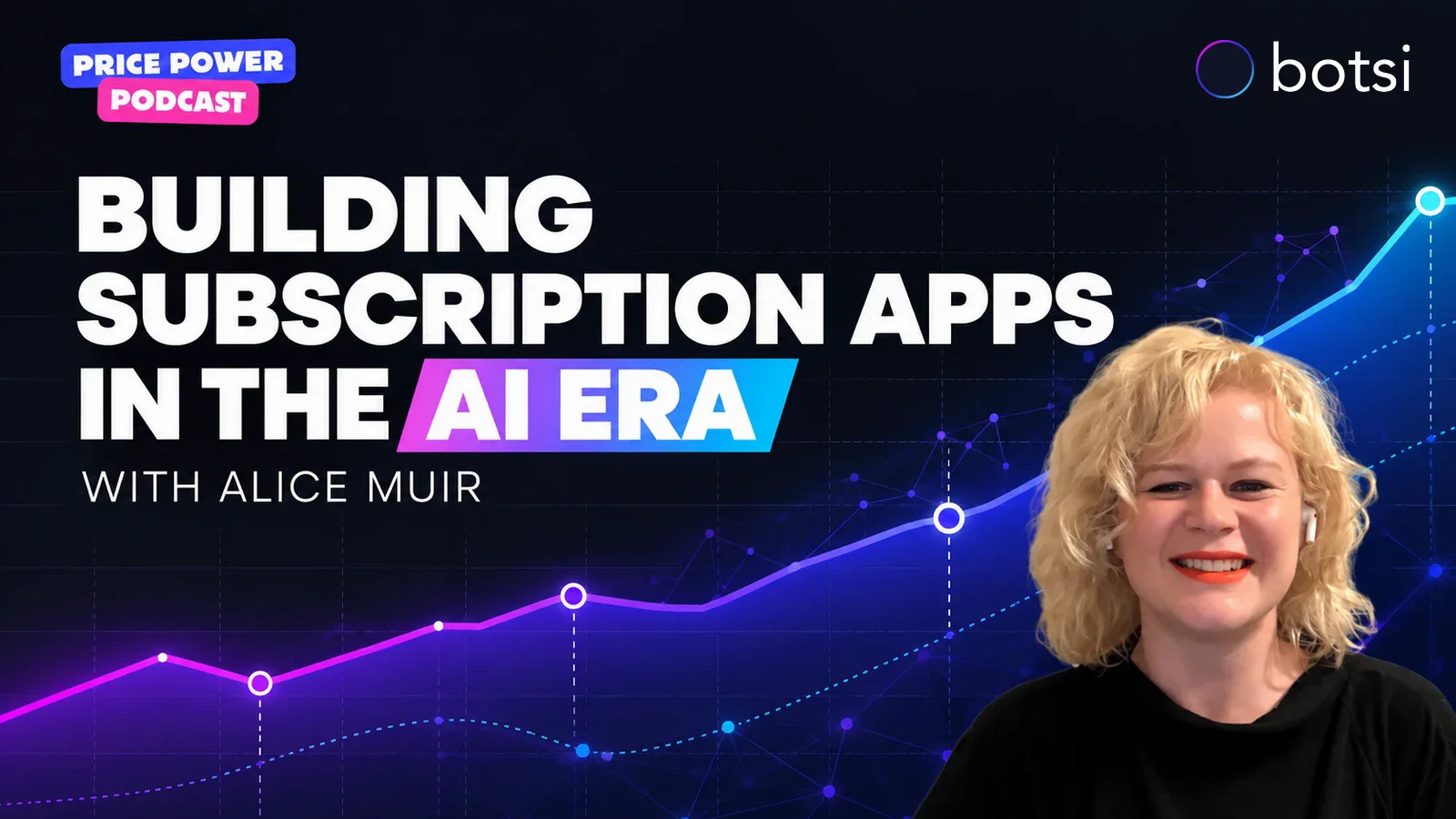
Alice Muir has worked on monetization and retention with Headspace, VSCO, Adobe and SoundCloud, co-authored the Subscription Stack framework, and has been independent for the past year working mostly with smaller, earlier-stage teams. She joins the Price Power Podcast to work through what AI actually changes about subscription apps, and what it does not. She is also clear about which parts of this nobody has figured out yet, including her.
Ten Tips from the Episode
1. Protect learning actions, charge for outcomes
A user should be able to learn what your product does and how it feels without paying. What you charge for is the outcome, the thing they came to get done.
The complication is new. In an AI product, letting someone learn has a GPU cost attached. So the rule needs a second layer: find the cheap actions and let those carry the learning. A short text prompt costs very little. Generating a ten-minute video with effects does not. Let people try a first prompt, and put the editing and iteration behind the paywall.
2. Strategic friction, and the cost of waiting
Strategic friction means giving away about 80 percent of the solution and holding the last 20, the part that completes the job properly.
MyFitnessPal is Alice's standing example. Their free tier let you log calories and macros manually, and also scan barcodes. Behind the paywall sat recipes and deeper nutrition detail. The problem was that barcode scanning is the speed and efficiency of the whole product, so anyone focused on calories in and calories out had no reason to subscribe.
They eventually moved scanning behind the paywall. Alice thinks the logic was right and the timing was years late, because by then users expected it for free. Ask which of your free features carries the value of the product.
3. Show the value without paying for it
If you cannot hand out the real thing, show what the real thing looks like.
For an app that shows you a new haircut or a color palette, you can demonstrate the before and after on an avatar during onboarding. For video generation, show a mockup of someone prompting alongside a typical output. The user understands what they would get without you rendering anything.
Alice also points at how Lovable and Claude handle this: when a prompt is ambiguous, they check the brief before spending. That matters enormously once credits are involved, because a new user burning their allocation on a misunderstanding is a user who never sees the value.
4. Hybrid monetization is back, for specific reasons
Over 90 percent of installs never subscribe. The old advice was to ignore them and focus on the 10 percent, which held up fine when free users cost nothing.
Alice splits the response in two. Established apps with a real user base, Duolingo and Notion among them, tend to keep AI for a higher-value tier and segment. AI-native apps, the face swaps and wardrobe generators, are better served by credits, usage-based pricing and ads, because they have no brand trust to hard paywall against and acquisition keeps getting more expensive.
Her warning for the first group: only layer in AI if it genuinely helps you deliver value better. If it cuts your margin without improving the product, it belongs behind a separate price and package, or nowhere.
5. The profitability stack is worse than it looks
The costs stack up fast, which explains the pressure these apps are under. In Alice's telling, past $1M ARR you move from Apple's 15 percent small business rate to 30 percent. Then normal business tax. Then GPU costs that scale with what your app actually does. Then the cost of running the company.
That demands real scale, at exactly the moment acquisition is getting more expensive. Alice calls it a chicken and egg problem, and thinks few teams will solve it well.
It also pushes prices up, which collides with what consumers have been trained to expect. People have had free trials for years and are now meeting hard paywalls immediately, without knowing why.
6. Margin-qualified acquisition
Traditional apps pay for hosting. AI apps pay for thinking. That changes who is worth acquiring.
Alice's practical version: whatever AI usage you give away before someone converts should be counted inside your CAC. If your trial includes one generated song, the compute for that song is part of what it costs to acquire that customer. It is not a product decision sitting in a different spreadsheet.
7. Let users tell you who they are at the paywall
An AI image and video app built three plans as personas rather than feature lists: someone curious and trying it out, someone working toward being a viral creator, and an established creator making hundreds of pieces a week who needs every credit available.
Users sorted themselves. No "what brings you here" quiz required, and the answer arrives at the moment it is useful. Most people picked the middle plan, which later let the team simplify around who they were actually acquiring.
Alice is running a version of this with a fitness client: a quarterly plan framed as an efficient twelve-week program for an event or for summer, and an annual framed for people making a lasting change. Same two plans, sorted by intent rather than by price.
8. Two plans is usually right. More is usually worse.
Two plans moves the decision from "do I buy" to "which do I buy", which is a much better question for you. Beyond that, choice starts costing you.
In fitness, where monthly, quarterly and annual is currently common, Alice sees the monthly and quarterly cannibalize each other and the annual go unchosen. The plan you most want people on ends up the one nobody picks.
9. Strip the paywall before you optimize it
Alice's proudest recent win came from deleting things.
The web-to-app paywall had a 60 percent off badge, a countdown timer, strikethrough prices, and per-day and per-week framings stacked on top of each other. The founder's objection was reasonable: Ladder and others do exactly this. Alice's answer is that it works at scale, where you can afford to lose people at the paywall because millions are arriving, and it does not work for an app still trying to get the funnel off the ground.
They did the back-of-napkin math on LTV targets and CAC, showed a single plan, and conversion came up to just over the 3 percent web benchmark. Roughly a sixfold improvement from simplification.
The related trap is copying patterns without their context. Almost all of Alice's clients have tried the Blinkist trial-timeline paywall. It works for habit-formation apps, where a reminder sequence matches how you would use the product. For a utility, nobody wants a push notification two days in.
10. The engagement layer of the playbook is broken
Asked what she would change about the Subscription Stack for AI-native apps, Alice says most of it holds. Onboard users properly, personalize the paywall, collect the right information and feed it into activation. None of that moves.
The exception is engagement, and it is a real break rather than a tweak. The entire framework assumed more usage was unambiguously good. Now, as she puts it, some of the highest engaging users are the least profitable. A revised version would need a whole section on identifying which users justify AI features economically, and which should be served with credit packs and usage limits instead.
Key Takeaway
If you are about to ship AI features, Alice's pre-flight checklist is short. Do the back-of-napkin math on GPU cost, modeling your worst case user rather than your average one. Keep cheap actions and expensive actions in separate cost centers so your tiers can be priced coherently. Be generous with the cheap things. And make sure the feature actually moves retention, because if it does not, all you have done is cut your own margin.
Her hot take: consumers do not care that your app is AI powered as much as publishers think they do, and in some cases it actively puts them off. A fitness app where all the coaches are AI reads as cheap, which is ironic given what it costs to run.
Resources
Alice Muir on LinkedIn: https://www.linkedin.com/in/alicemuir/
Listen to the Full Episode
Youtube
Spotify
Apple Podcasts
Check out past episodes here: PricePowerPodcast.com