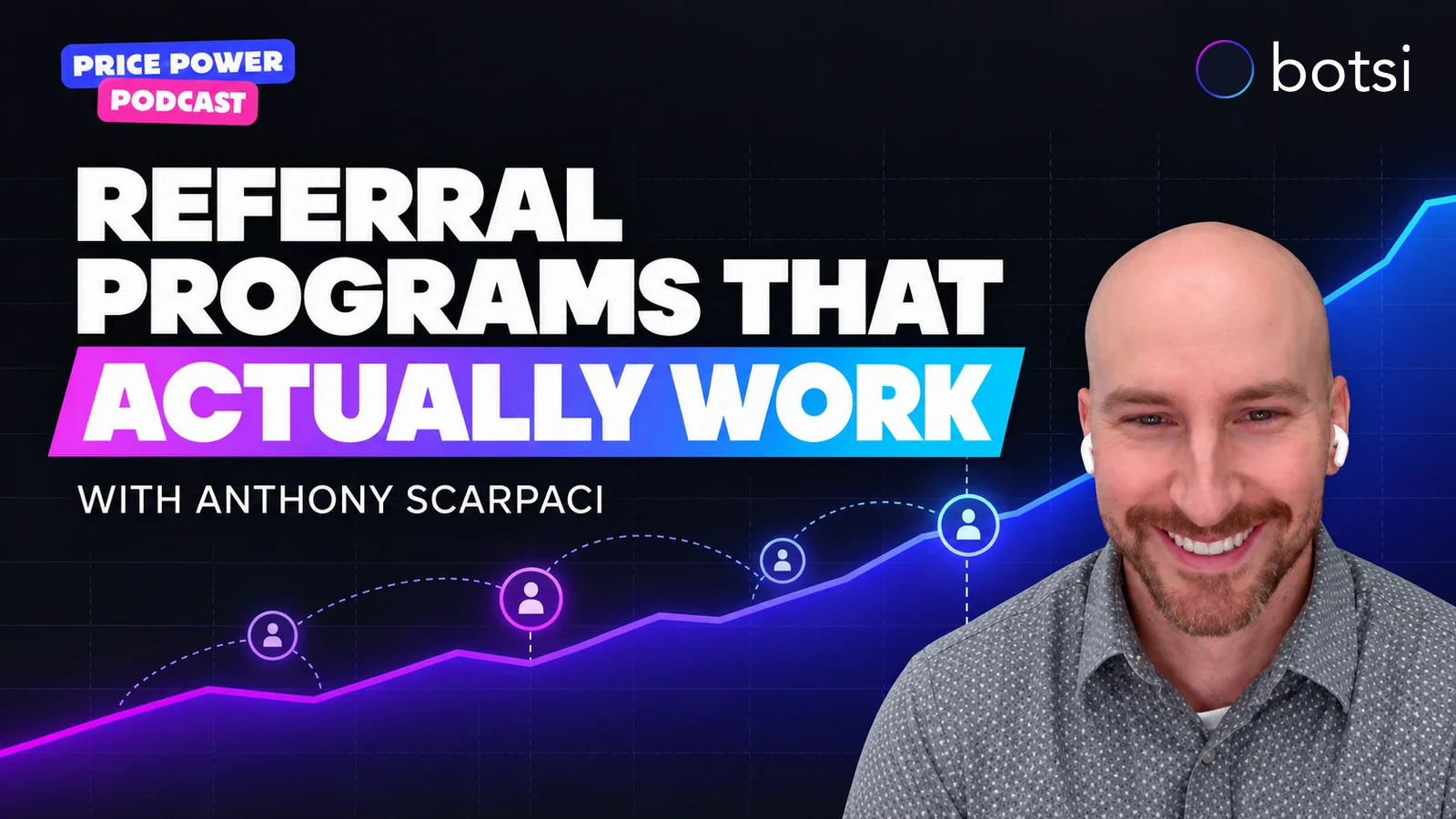
Anthony Scarpaci was global VP of Growth at Acorns and a senior director at NerdWallet, with earlier growth roles at Betterment and Blue Apron. He now advises consumer subscription brands. He joins the Price Power Podcast to talk about referral programs: everyone knows what they are, and most of them are mediocre. He brought a framework he calls RIGHTT, which stands for relevance, incentive, guardrails, human-centricity, timing and tracking.
Ten Tips from the Episode
1. Start with relevance, not the incentive
The common failure is reaching straight for cash. If cash has nothing to do with your product or the customer's relationship to your brand, it can be jarring rather than motivating.
GoHunt, a hunting research and mapping subscription with an ecommerce arm, gives points redeemable for hunting and camping equipment. The reward feeds directly back into why the customer is there. Dish Network, where Anthony worked early in his career, ran a heavily direct-mail program built on gift cards. It worked, but it never connected to the brand's value. They have since moved to points for things like on-demand movies.
Financial services is the exception. At Acorns or Betterment, money is the product, so cash incentives are coherent. Everywhere else, moving off cash stops customers mentally filing your program alongside other ways to make a bit of money.
2. A guarantee beats a chance
Incentives have got harder, because consumers are saturated with give-X-get-X offers and mostly ignore them. One reliable way through is certainty.
Anthony has seen repeated tests of sweepstakes against guaranteed rewards, and the guarantee tends to win even when the sweepstakes prize is far larger. People do not believe they will actually be the winner, so they do not act. Say plainly that these specific actions earn this specific reward. Urgency is the other lever: a time-bound offer converts better than an evergreen one.
3. Big prize plus low friction produces worthless leads
At a previous company, influencers promoted a sweepstakes and single-day lead volume exceeded anything the business had seen. The CEO thought it was transformational.
As the cohort matured, conversion was so low the economics turned out unexciting. Anthony's framing is a simple equation: how attractive is the prize, and how little friction is there to enter? Win a million dollars for an email address and of course people enter. None of them want your product.
The fix is to tie the incentive to actions that correlate with retention. Ask your product team which behaviors in the first session or first seven days predict a long-term customer, then require those.
4. Use asymmetric rewards
Work back from your unit economics, but do not stop there, because a naive calculation misses three things.
Cannibalization pulls the number down, since people who would have referred anyway now get paid for it. Halo pulls it up, and occasionally sharply: one influencer mentioning the program can produce genuinely incremental reach.
And non-cash rewards break the symmetry in your favor. If a customer perceives $100 of value in a shirt that costs you $10, a two-sided reward costs $20 rather than $200. Credits behave the same way, depending on how many go unredeemed and whether redemption carries margin.
5. Guardrails mean requiring real usage
Pre-IPO Blue Apron, along with the rest of the meal kit category, gave a free box to a friend with no strings attached. Two problems followed. People gamed it from the same address or by changing locations. More importantly, the friend got a free box and no reason to form a habit.
HelloFresh now requires a series of deliveries before the reward lands, so the referred customer actually tries the product and finds out whether it fits their life. Less immediately generous, considerably more sustainable.
On the analysis side, watch historical cohorts monthly, or weekly if the outlay is large. Compare their conversion and lifetime value against your normal LTV curve. If referred cohorts underperform, you will see which customer profiles are collecting the incentive and leaving.
6. The optimal level of fraud is not zero
The episode opens on this idea, and it applies well beyond referral.
Every increment of fraud prevention adds friction for customers acting in good faith. So you accept some level of gaming in exchange for the total contribution and scalability of the program.
The comparison that matters is not referral against no referral. It is referral against the next best place to put that money, and paid channels carry their own fraud and inefficiency, particularly in programmatic. A program with some leakage can still be your most efficient acquisition source.
7. Map the journey so it stays consistent
Anthony sees the same inconsistency across funnels generally: the ads say one thing, registration says something slightly different, and onboarding says something else again. Usually because different people own different stretches and nobody owns the whole.
For referral specifically, put every touchpoint in one file and walk it. Does the new customer, who knows nothing about you, understand who you are and what problem you solve? Is it reinforced at each step that this came from a friend they trust, and that both of them get something? Does the incentive visibly follow them through signup so they know they are in the right place?
8. Tell people when they've earned the reward
Plenty of programs credit the account and never make a moment of it, which quietly breaks the loop.
That notification is what makes the loop a loop. One person referring one friend is not viral growth. The referrer feeling the payoff and going back for a second and a third is. If you skip the moment, you get a single referral per customer and wonder why it is not compounding.
9. Timing is three questions, not one
Is the business ready? You want to be post product-market fit, with customers who genuinely like you, and enough scale that the program can matter. Below that, you mostly cannibalize the word of mouth you were getting free, which inflates your blended CAC for no gain.
When in the customer journey? Often at the point of trial, framed as let's try this together. Or at a moment of delivered value, right after the product has done something good for them.
And how often? An evergreen low-level program will not scale on its own. Acorns ran large periodic incentives, several hundred dollars for referring five people, as a stopping factor against the background noise. The caution is not to over-condition people. Once customers expect large incentives, that is a one-way door. Black Friday is the cautionary analogy: REI and Patagonia can opt out because it fits their brand, and almost nobody else in the category can.
10. Incrementality is genuinely hard, so triangulate
Anthony calls referral one of the hardest attribution puzzles in the acquisition mix, and he does not pretend otherwise.
Three approaches. Run a how-did-you-hear-about-us survey before you launch, so you have a baseline for how many people say a friend, then watch the delta afterward. Do a pre/post analysis of blended CAC across a clean period with no seasonality: if customer volume held flat and CAC jumped by the cost of the program, it was not incremental. And holdouts, which sound right and mostly are not, because friend networks cross any geographic split and you cannot isolate interaction effects.
Two things to track once it is running. Referrer distribution follows a power law, which Jacob put closer to 1/99 than 80/20, much like a mature affiliate program. And read referral rate by customer tenure rather than blended, because new customers refer more simply by virtue of the program being new to them, while five-year customers have already told everyone they are going to. Your K factor is the base of possible referrers times referrals per customer times the stepwise funnel conversion.
Key Takeaway
Referral is not right for everything. Anthony weighs the reputational risk the referrer takes on. Recommending Acorns, where a friend invests spare change, costs almost nothing if it disappoints. Recommending that someone move their entire retirement account is a different ask, and the incentive would have to be big enough to cover the discomfort. There are cultural considerations too: in the nonprofit world, taking money to refer a friend to a mission may feel wrong.
Done well though, it is one of the few tactics that improves acquisition and the retention of the person doing the referring at the same time. And it is a channel you fully own, which makes it more predictable at scale than paid or SEO as those get more volatile.
Resources
Anthony Scarpaci on LinkedIn: https://www.linkedin.com/in/anthonyscarpaci/
Tunomatic: https://www.tunomatic.com/
Growth Notes newsletter: https://tunomatic.substack.com/
Listen to the Full Episode
Youtube
Spotify
Apple Podcasts
Check out past episodes here: PricePowerPodcast.com