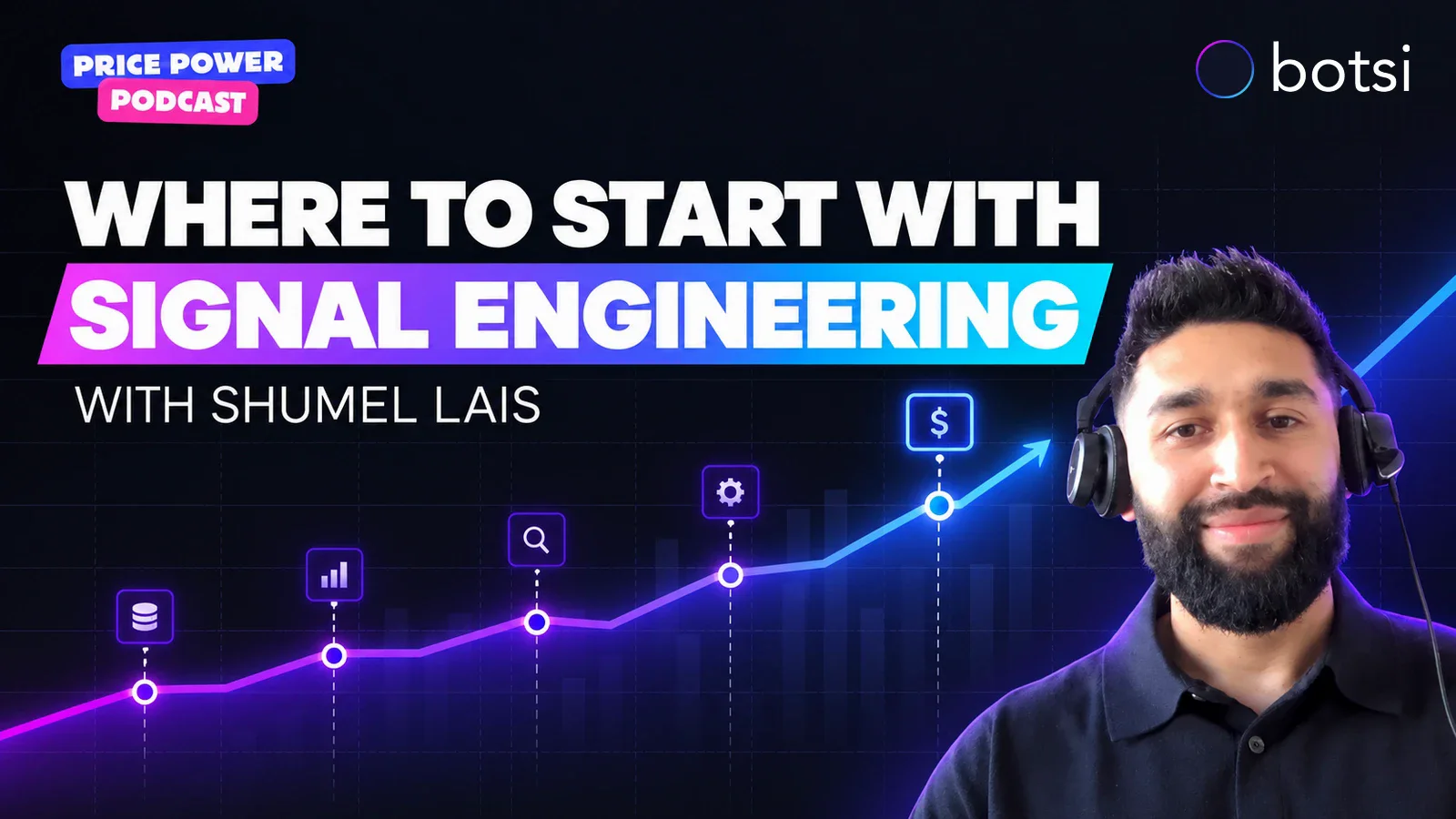
Shumel Lais co-founded Day 30 and has worked in mobile growth since 2010, starting at Fetch when there were only a couple of mobile agencies, no MMPs, and no Facebook mobile ads. He joins the Price Power Podcast to explain what signal engineering means in practice, what you need in place before it is worth attempting, and the point below which you should ignore the topic entirely. He is also clear that the idea came out of a campaign he got wrong himself.
Ten Tips from the Episode
1. Signal engineering is choosing a better goal event
Shumel credits the term to Thomas Petit and Eric Seufert, though he and his co-founder were working on the underlying idea before it had a name.
The problem it solves is structural. Platforms like Meta have taken away the controls marketers used to have, bids, budgets, targeting, and replaced them with one instruction: tell us your goal and we will find people who hit it. Meta can see roughly seven days. What a subscription app cares about is revenue and ROAS that show up much later.
Shumel's closing line defines it: signal engineering is going down funnel, designed so that you go down funnel before the user actually has.
2. Start with a qualified trial, not a model
At the simplest level this is event selection, no machine learning involved.
Most apps optimize to trial start, because everyone who subscribes passes through it. The basic upgrade is trial start plus a behavior: a language app might use trial start plus five lessons completed. The other common version is a qualified trial, meaning a trial where the user did not cancel within the first hour.
How well that works depends on your audience. Younger demographics are fluent in canceling immediately, so a lot of the cancellations cluster up front and the filter catches them. Older users are more likely to actually test the app, so fewer cancel early and the signal does less work.
3. Recall is the metric you're not measuring
Recall, a metric borrowed from data science, asks: of everyone who actually converted, how many did your signal capture? Trial start has 100 percent recall, since nobody converts without it. That is its main virtue.
Now take a photo storage app that notices converters upload a lot of photos, and draws a line at 10,000. Plenty of people upload 4,000 and convert anyway, and the cutoff throws all of them away. Measuring recall lets you put a number on what you are losing. Sometimes losing it is fine, because the people you do send are very likely to convert. But you should know.
4. Climb the measurement ladder first
Shumel's five stages, in order. One, no MMP at all, just App Store Connect or RevenueCat revenue compared against spend. Two, platform attribution via the Facebook SDK or a web pixel. Three, an MMP in place. Four, internal alignment on cohorted metrics rather than deliverables. Five, media mix modeling and incrementality.
You want to be at three or four before attempting signal engineering, because otherwise you cannot measure whether it worked. Stage five realistically needs two years of history and seven figures of monthly spend.
Stage four is the one teams skip. Platforms default to deliverables, revenue generated today, rather than revenue from users who installed today. Until everyone agrees whether ROAS means day 7, day 30 or day 60, you are not comparing like with like.
5. Get an MMP, even on a small budget
Shumel's answer is yes, even at a few hundred dollars a day, and most MMPs have free tiers with enough credits to start.
The reason is specific. Meta's metrics are based on the day the event happened, not the day of install. So Meta can serve your ads to people who already have the app, their renewal fires as a purchase event, and Meta claims it. You end up paying to reach existing subscribers and reading it as acquisition.
The second reason is multi-channel. Run Apple Search Ads alongside Meta and ASA will cannibalize Meta conversions on last touch, particularly on brand terms, because people see an ad and search for you later.
6. Ten conversions per campaign per day
Ten conversions per campaign per day is the floor for ML-based signal engineering. If your current trial starts are not clearing ten per campaign per day, do not go further down funnel, because you will starve the algorithm.
Ten sounds low until you cost it. Cost per trial can run anywhere from $20 to $100 depending on market, and the US is at the high end. Ten a day at those numbers is a real budget.
7. Your behavioral data probably isn't where you need it
The models are only as good as the data behind them, and Shumel says it is rare to find enough behavioral data tagged in the MMP. It usually lives in Mixpanel or Amplitude.
The models ingest all of it, split users into converters and non-converters, and look for clusters. A simple decision tree might branch first on whether someone cancelled within an hour, then on a product event, then by geo, finding pockets of users with distinct conversion rates.
The output is a probability per user. You can apply it to revenue as well, which matters more in gaming than subscriptions, because subscription revenue has less variability. If you do send revenue values, normalize the whales, or Meta will spend heavily chasing users who may not convert.
8. The MMP is for measurement, not the signal itself
You can send signals to Meta directly through the Conversions API without an MMP in the path.
The reason Shumel wants an MMP is that he never runs signal engineering blind. He runs a campaign optimizing to trial start against one optimizing to the predictive subscriber event, and compares day-30 ROAS. Without an MMP you cannot answer that question. The MMP has a secondary use as a distribution point: send the signal there once and it can forward to TikTok, AppLovin and Liftoff as well as Meta.
9. Send signals fast, for two separate reasons
Server-side events are the hard case. Trial conversions happen on Apple and Google's infrastructure rather than in your app, which is why RevenueCat powers so many of them, and those events consistently match worse. There are fewer parameters available for probabilistic matching, and the longer the window, the weaker the match.
The second reason has nothing to do with matching. If Meta sees purchases landing on day seven, it effectively waits seven days after a click to find out whether a user was good. Give it a quality signal within a day and it can make that call immediately, which speeds up the whole learning loop.
10. Decide deliberately between volume and quality
Signal volume stops mattering much somewhere between 10 and 30 conversions per campaign per day. If you are at 20 and a qualified trial cuts you to 14 while raising precision, take the trade.
Past 30 or 40 per campaign per day, the logic inverts and you are leaving money on the table by not pushing deeper. And it compounds: a better signal drives performance, performance lets you scale spend, more spend restores the volume, and you can go deeper again.
Before any of that, back-test. Apply your proposed qualified-trial logic to the last 30 days and see how much volume it would have removed. If the answer takes you under the floor, you have your answer without spending anything.
Key Takeaway
If you want somewhere to start this week, Shumel's first two checks are unglamorous: compare the match rate between Meta and your MMP, since a large gap points at something structural, and get your team aligned on what window your cohorted ROAS and CAC actually use.
His hot take for marketers: in 2026 marketers should stop hiding behind attribution or measurement problems, and blended CAC is comfortable precisely because the direct number is always worse.
Resources
Day 30: https://day30.ai
Shumel Lais on LinkedIn: https://www.linkedin.com/in/shumellais/
More on this topic: Signal Engineering 101
Listen to the Full Episode
Youtube
Spotify
Apple Podcasts
Check out past episodes here: PricePowerPodcast.com