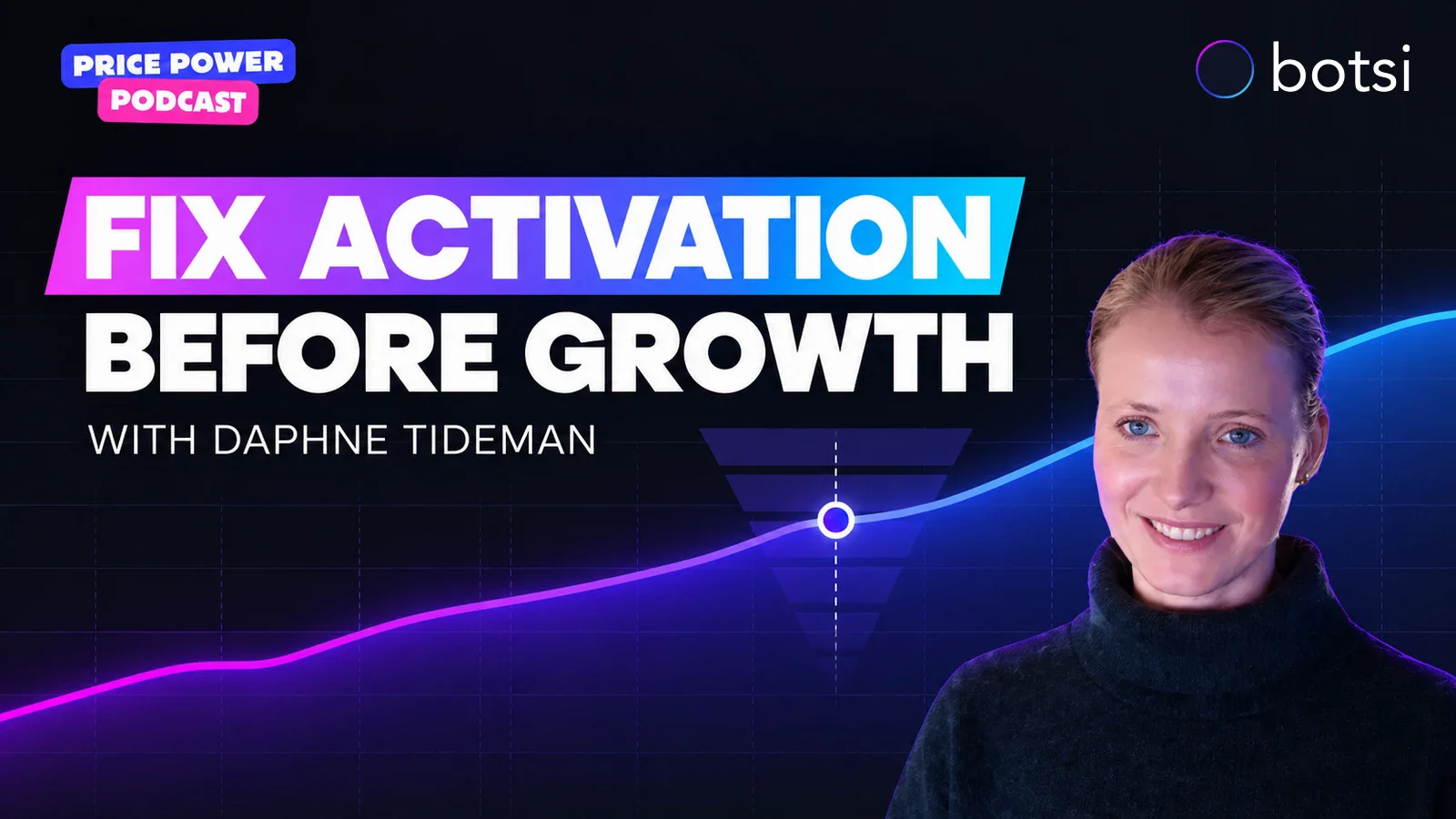
Daphne Tideman is a growth advisor who runs audits for startups and scale-ups, mostly in wellness, and writes the Growth Waves newsletter. She spends a lot of her time inside other people's analytics, which is where most of the examples here come from. She joins the Price Power Podcast to make a case she has been making to clients for years: the retention problem you think you have is usually an activation problem you have not diagnosed.
Ten Tips from the Episode
1. Onboarding completion is a vanity metric
Daphne audited an app with onboarding completion above 90 percent on both iOS and Android. Most users were gone by day two.
The onboarding was short and easy, a few simple questions with low cognitive load. The product underneath was complex. People finished the questions out of curiosity, arrived at the real product, and had no idea what to do next. Some started a trial anyway, then faced a long setup and gave up.
The fix was to make onboarding longer and move some of the setup into it, so people felt something before the paywall. Completion dropped. Retention improved. That is the trade most teams refuse to make, because completion is the number on the dashboard.
2. Trial starts can be a vanity metric too
The same logic applies one step down the funnel. Daphne has seen teams lengthen a trial, watch trial starts go up, and end up with fewer paying customers, because a longer trial gives people room to procrastinate and never really try the product.
Any metric you can inflate without the user getting more value is a metric that can lie to you.
3. Fix activation before monetization
When Daphne sees both an activation problem and a monetization problem, she goes for activation first, because monetization tends to follow. The exception is a genuine pricing or packaging mismatch.
One distinction matters if you are freemium: an activated user who pays is a different thing from an activated user who does not. If you want activation work to drive revenue, define it against paying users. If you want it to drive referrals and reach, define it against free users.
4. Build mini value moments, not one big aha
The usual objection to value-before-paywall is technical. A workout app cannot make you do a workout during onboarding.
Daphne's answer is to stop looking for one large moment. Ladder tells you it was made for people like you, which lands because the ads already showed you the outcome. Opal explodes a gem when you block your first thing, which has nothing to do with the real product and still makes you feel like you are taking control. Smaller moments, more often, beats waiting for the big one.
5. Put the aha moment in your ads
Most teams never consider this, because they file activation under product.
Show the job to be done and the transformation. Mimo, a coding app, found one of its best performing ads was someone coding in a lift. You see that this person found time, which is exactly the thing the viewer does not believe about themselves. If your outcome is harder to show, use a testimonial or a before and after.
Every app is asking users to believe it will deliver something. The ad is where that belief starts, and five user interviews will tell you which emotion is actually blocking them.
6. Stop calling it day-two retention
For most apps Daphne works with, activation is a seven to thirty day process of building a habit. Teams measure that window and call it retention, then wonder why retention tactics do not fix it.
If people are dropping at day two, you are not losing retained users. You are failing to activate them. The name sends teams toward win-backs and push campaigns when the problem is upstream.
7. Separate time to first value from time to core value
Time to first value is the small moment where someone thinks this could work for me. It should happen in the first session, and it can be as small as learning something. Noom's personalized plan and the reassurance around it is first value, not core value.
Time to core value takes longer and usually means doing the thing repeatedly until you feel a difference. For Blinkist, first value is realizing you can get through a summary and it fits your life. Core value might be finishing a book or holding a three-day streak.
Splitting them helps because when core value is too far out, the fix is usually to pull first value closer, not to push harder on the end goal.
8. Test whether your activation metric is real
Daphne's checks: activated users should retain significantly better, and that should hold across cohorts and channels rather than coming from one strong organic source. The metric should also move downstream numbers, including paid conversion. And it should match what users describe as valuable, which is not always the same as what you need them to do.
If you do not have the data yet, do not track everything and wait. Start with user interviews, define the metric you believe in, instrument it, and start gathering.
9. Look at dose, not just a threshold
Any action beats no action, so almost everything correlates with retention. That is why single thresholds mislead.
For one app, connecting with friends drove retention: one friend helped, three helped more, five more again, ten most of all. But the cohort reaching ten was tiny. The usable target was three to five, because the effect was real and a meaningful share of users could get there. Check both the size of the effect and whether it is realistic to expect.
10. Diagnose activation versus retention before you fix either
Start with the retention curve, split by subscription type and by platform. Then ask a simpler question: were these users ever active?
If they took action early and then trickled off, that is a retention problem, and the work is habit and staying relevant as the user changes. If they were never active, they were dormant from the start and the problem is activation. Daphne also checks what the acquisition campaigns optimize for, because a flood of low-quality installs can make an activation problem look like something else.
Key Takeaway
Daphne's preference for activation over win-backs is arithmetic. A win-back campaign works on the small group you already lost. Activation works on everyone arriving. Her single biggest observed mistake, and the one she would fix first in most apps, is having no value moment before the paywall at all.
Her hot take, aimed at other advisors rather than clients: revenue is a terrible North Star metric, because it makes you optimize for extracting value rather than creating it.
Resources
Growth Waves newsletter: https://growthwaves.substack.com/
Daphne Tideman on LinkedIn: https://www.linkedin.com/in/daphnetideman/
Listen to the Full Episode
Youtube
Spotify
Apple Podcasts
Check out past episodes here: PricePowerPodcast.com